

Dominican Republic Retirement Visa: Your 2026 Path
A Dominican Republic retirement visa is within reach for many retirees because the Pensionado route starts at US$1,500 per month in guaranteed pension income, plus US$250 per dependent. That low threshold is a big reason the Dominican Republic remains one of the most accessible retirement pathways in the Caribbean, but in 2026 the main challenge isn't eligibility. It's getting the paperwork right the first time.
Individuals who contact us are not confused about why they want to move. They already know what they're chasing: warm weather, a simpler cost structure, and the ability to trade long winters for mornings near the beach. What slows them down is the part nobody romanticizes. Document collection, consular filing, apostilles, timing, and the question every retiree asks at some point: "Can I get this done without spending months correcting mistakes?"
The answer is yes, but only if you approach it like an administrative project, not a casual relocation wish list. The Dominican system can work very well for retirees. It can also punish incomplete files, mismatched certifications, and assumptions based on outdated advice.
If you're considering a move to Las Terrenas, our earlier overview on retiring in the Dominican Republic is useful background. Here, the focus is narrower and more practical: how the Pensionado process works on the ground in 2026, where applicants lose time, and when the investor route may fit better than a classic retirement application.
Table of Contents
- Your Caribbean Retirement Dream and How to Secure It
- What Is the Pensionado Retirement Visa
- Confirming Your Eligibility and Income Requirements
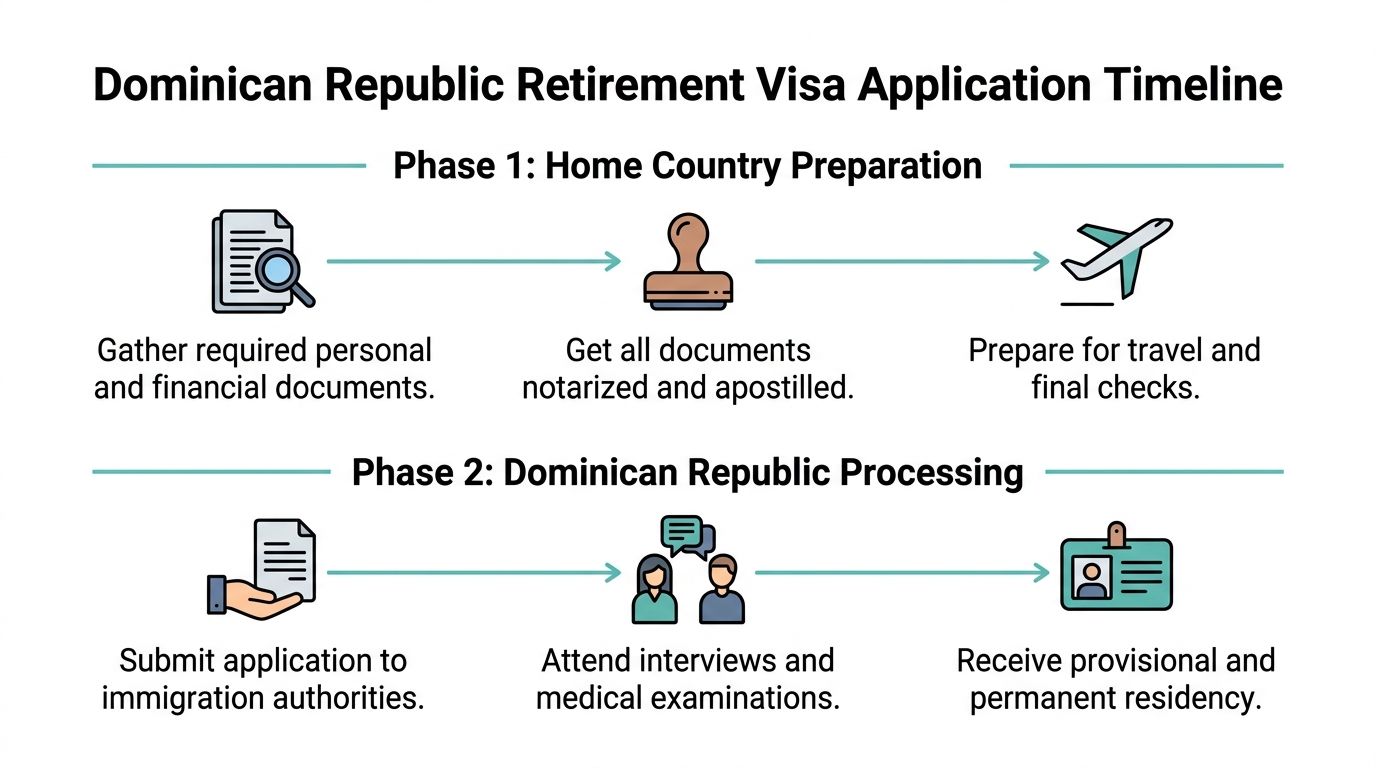
- The Step-by-Step Application Timeline
- Navigating Costs, Timelines, and Common Pitfalls in 2026
- Retirement Visa vs Other Dominican Residency Options
- What Your Life in Las Terrenas Will Look Like
- Frequently Asked Questions about the DR Retirement Visa
Your Caribbean Retirement Dream and How to Secure It
Retirement in the Dominican Republic usually starts as a lifestyle decision and quickly becomes a paperwork decision. One month you're comparing beach towns and healthcare options. The next, you're trying to figure out whether your pension letter, passport validity, and police clearance all line up in the format immigration expects.
Las Terrenas tends to pull in exactly that kind of retiree. People who want the beach, but not isolation. People who want restaurants, services, and an international community, but don't want to feel trapped in a resort bubble. Playa Bonita, Cosón, Portillo, and the area around Pueblo de los Pescadores all offer different rhythms of daily life, and that matters once you're relocating, not just visiting.
The visa route that matters most for retirees is the Pensionado visa. It exists for people with stable retirement income from a verifiable source, and for the right applicant it's the cleanest path into legal residency. The attraction isn't just the income threshold. It's that the route is designed around retirees rather than forcing them into a standard residency track built for everyone else.
What retirees usually get wrong first
The common mistake is thinking approval turns on one number alone. It doesn't.
A retiree may fully qualify financially and still lose months because a certificate isn't properly legalized, a supporting bank document doesn't match the pension issuer's name, or a file gets assembled in the wrong sequence. Generic summaries make the process sound linear. On the ground, the sequence matters almost as much as eligibility.
A strong application is less about proving you're retired and more about proving your documents tell one consistent story.
What works better than improvising
The people who move through this process with less stress usually do three things early:
- They verify the source of income clearly. Retirement income needs to be easy to trace to an official payer or institution.
- They build extra time into every document step. Issuance, notarization, apostille, translation, and consular review rarely move at the same speed.
- They decide their residency strategy before buying property. That matters in Las Terrenas, where some retirees should apply as Pensionado and others are better served by the investor route tied to a purchase.
If you treat the Dominican Republic retirement visa as a practical filing exercise rather than a vague future plan, it becomes far more manageable.
What Is the Pensionado Retirement Visa
A retiree lands in Santo Domingo with a pension approval letter, a clean passport, and a purchase contract for a condo in Las Terrenas. On paper, the case looks simple. In practice, the Pensionado route works best when the income source is clearly pension-based, the document set is consistent, and the buyer has already decided whether property ownership is part of the residency strategy or just part of the move.
The Pensionado visa is the Dominican Republic's residency pathway for foreign retirees who can prove recurring pension income from a recognized source. It is designed for people living on retirement benefits, not for applicants trying to fit rental income, freelance work, or irregular investment withdrawals into a retirement category.
Why this route appeals to retirees
The appeal is practical. Retirees who qualify under Pensionado are processed under a residency track built around pension income, which is usually more direct than filing through ordinary residency categories.
According to this retirement residency breakdown, the program is structured around a defined pension threshold and a special residency treatment for retirees. That matters in 2026 because applicants are less concerned with marketing labels than with how quickly they can get through consular review, local medical exams, residency card issuance, and renewals without avoidable delays.
I also tell clients to separate two decisions that often get mixed together. One is where to live. The other is which residency category fits the file.
If you're buying in Las Terrenas, the comparison usually comes down to Pensionado versus investor residency. Pensionado is often the cleaner route for retirees who already receive a documented pension and are buying a home for lifestyle reasons. The investor visa can make more sense when the property purchase itself is central to the residency plan, especially if the applicant's income profile is stronger on assets than on pension documentation. Buying real estate does not automatically make the investor route better.
What the status means in practice
This category is favorable, but it is not effortless.
Applicants still deal with document legalization, official translations, medical checks in the Dominican Republic, card processing, and later renewals. The difference is that the legal basis of the application is narrower and usually easier for immigration to assess when the pension trail is clear.
That clarity is where many files either hold up or move.
A pension award letter with one name format, bank deposits under another variation, and supporting statements with incomplete transaction detail can slow a case even if the applicant qualifies. If you need to verify how statements should read before filing, review these bank statement requirements for a visa. It is a small detail that causes outsized delays.
A useful way to frame the Pensionado route in 2026:
- It is a residency option based on pension income, not general wealth.
- It usually works better than ordinary residency for retirees whose paperwork is clean and traceable.
- It is not always the best choice for a buyer in Las Terrenas whose strongest argument is an investment, rather than a formal pension stream.
- It still involves local processing steps that generic government summaries tend to gloss over.
Some articles get stuck on whether the category should be described as immediate permanent residency or as a faster route into long-term status. For applicants, the practical question is simpler. Will this filing path match your documents, your income source, and your property plan better than the alternatives? That is the right test.
A short explainer helps if you want a visual overview before getting into the file mechanics.
Practical rule: Choose the Pensionado category only if your pension evidence is strong, your paperwork is consistent, and the investor route would add complexity rather than solve a real eligibility problem.
Confirming Your Eligibility and Income Requirements
A common 2026 scenario looks like this. A couple has enough money to retire in Las Terrenas, one spouse receives Social Security, the other draws from an investment account, and they assume the retirement visa is the obvious fit. On paper, they feel qualified. In practice, the file only works if the income can be shown as a formal pension stream that Dominican authorities can trace cleanly from issuer to applicant.
That is the first filter to apply before you spend time and money on apostilles, translations, and consular appointments.
For the Pensionado route, the benchmark is a guaranteed monthly pension. The commonly cited threshold is $1,500 USD per month for a principal applicant, $1,750 for a couple, plus $250 for each additional dependent. There is also no fixed retirement age written into the category, which catches some early retirees off guard. Age is usually less important than document quality and the nature of the income.
What income usually works
The strongest files are simple to read and simple to verify. In my experience, the following sources tend to fit best:
- Government pension income from a public retirement authority
- Social Security or an equivalent state retirement benefit with official award letters or benefit statements
- Private pension plans or annuities where the payment is contractual, recurring, and issued by a recognized institution
Those categories make the reviewing officer's job easier. That matters more than applicants expect.
What creates trouble
Problems start when retirees try to present wealth as if it were pension income. A healthy net worth helps your personal planning, but it does not automatically make you a Pensionado applicant.
These items often need a different strategy:
- Salary from active employment
- Business distributions
- Rental income
- Portfolio withdrawals that you control month to month
- Large balances sitting in a bank account without a pension letter behind them
The comparison with the investor route becomes practical, especially for buyers looking at property in Las Terrenas. If your strongest case is the estate purchase itself, or funds committed to an investment structure, the investor category may fit the facts better than a retirement filing. If your case is built on a pension award that lands every month from the same source, Pensionado is often the cleaner route.
What to confirm before you file
The applicants who avoid long delays usually check four things early.
First, confirm that the name of the payer is consistent across your pension letter, bank deposits, passport, and any translated documents. Small differences, including abbreviations or old married names, create avoidable requests for clarification.
Second, confirm that the income is regular and documentable, not just sufficient. Officers and support staff want to see the source, the amount, and the pattern. If you are preparing financial records, these practical notes on bank statement requirements for a visa help clarify what a readable file looks like.
Third, check your dependent setup before anything is legalized. If a spouse is joining later, or an adult dependent has a separate document issue, that should be addressed at the start. Retroactive fixes are slower and more expensive.
Fourth, look at timing. Pension letters, police certificates, and civil records can expire for filing purposes if you gather everything too early. In 2026, that timing issue is one of the most common reasons a file that looked complete in January has to be rebuilt by spring.
The best Pensionado file is dull to review. Clear pension source, matching names, readable statements, and no unexplained money moving between accounts.
One final planning point matters for Las Terrenas buyers. If you are buying property and your pension income is solid, the retirement route can be faster and less document-heavy than building an investor case around the purchase. If the pension evidence is weak and the investment evidence is stronger, the opposite is often true. The right choice depends less on what you plan to buy and more on which story your documents can prove without strain.
The Step-by-Step Application Timeline
A typical retiree starts this process in January, plans to be settled in Las Terrenas by Easter, and assumes the hard part is choosing the condo. In practice, the file prep usually decides whether the move stays on schedule. The Dominican Republic retirement visa is a two-stage process, and each stage can stall for different reasons.
Phase one in your home country
This stage is paperwork, but it is not simple paperwork. It is where applicants either build a file that moves cleanly through the consulate or create a chain of small defects that only show up after arrival.
Start with the core documents: passport, birth certificate, police clearance, pension evidence, and any marriage or dependent records tied to the case. The practical issue is not just collecting them. The documents have to match each other. A missing middle name, an old passport number on a pension letter, or a translated certificate that does not mirror the original can slow the file more than retirees expect.
Then comes legalization and translation in the correct order. In 2026, this is still one of the most common failure points. A document can be genuine and still be rejected because the apostille was done on the wrong version, the translation was prepared too early, or the consulate wants a fresher issue date than the applicant realized.
The consular filing for the residency visa (RS) comes after the document set is ready. That step matters because it sets up the legal entry path for the residency stage inside the Dominican Republic. Clients who book flights before the consular piece is in order often end up paying change fees, extending temporary stays, or rushing local housing decisions while the visa side catches up.
A reliable phase-one sequence looks like this:
- Gather civil, police, pension, and family records.
- Review every name, date, and reference number for consistency.
- Legalize and translate in the order the receiving offices expect.
- Submit through the Dominican consulate with a file that is still within validity windows.
- Travel only after the visa basis and timing are confirmed.
For retirees buying in Las Terrenas, this is also the point where the retirement route and investor route start to separate in a practical way. If the pension file is clean, the Pensionado path is usually more direct than trying to prove an investment structure around a property purchase. If the property transaction is already well documented but the pension evidence is thin, the investor visa can be the cleaner fit. The better route is the one your documents can support without repair work.
Phase two inside the Dominican Republic
After entry, the process shifts from document assembly to local execution. Timing still matters.
Applicants complete the local immigration filing, attend the required medical exam, and then wait for the residency and identification sequence to move forward. The medical step is routine, but it needs to be scheduled and completed promptly. Delays here can throw off the rest of the calendar, especially for retirees trying to coordinate a lease start, a property closing, or a furniture shipment into Las Terrenas.
The local stage works best when handled like an appointments calendar, not a loose to-do list. Keep copies of every submission receipt. Answer clarification requests quickly. Watch expiration dates and pickup windows. A file that is technically approved can still become frustrating if the applicant misses a local instruction or leaves the country at the wrong point in the process.
The cleanest in-country sequence is:
- Enter using the correct visa category
- Complete the medical exam on schedule
- File the local residency application with immigration
- Reply to follow-up requests without delay
- Track card issuance, cedula timing, and later renewal dates
Official descriptions often make the timeline sound shorter and more linear than it feels on the ground. In 2026, retirees should expect pauses between steps, occasional requests for reissued documents, and scheduling gaps that do not appear on government checklists. That is normal. The file usually moves best when each stage is prepared before the previous one finishes.
Navigating Costs, Timelines, and Common Pitfalls in 2026
The biggest misunderstanding we see is this: retirees assume the official steps are the actual timeline. In 2026, they often aren't.
Applicants should plan for a slower process than many older articles suggest. According to Alliance Visas' Dominican Republic retirement visa update, average processing times in early 2026 are running 6 to 9 months, and rejection rates for incomplete applications are around 28%, especially where apostilles are improper or pension documents can't be verified.
The timeline most people should plan for
That 6 to 9 month expectation changes how you should organize the move.
If you're planning to retire into a leased apartment first and buy later, the slower timeline affects your entry strategy, housing schedule, and document freshness. If you're timing a property closing, shipment, or private insurance decision around a fast approval assumption, you're likely setting yourself up for avoidable stress.
Government fees are only part of the cost picture. Earlier in the article, we covered the official fee range tied to the Pensionado route. In real life, applicants also need to account for translations, certifications, travel coordination, medical requirements, and professional help if they don't want to manage every filing detail personally.
The mistakes that keep files from moving
The 2026 rejection figure is useful because it points to something very concrete. Most failures are not philosophical. They are administrative.
These are the errors that regularly create trouble:
- Improper apostilles. A document can be genuine and still unusable if legalization is defective.
- Weak pension verification. Officers need to connect the monthly amount to an identifiable, credible source.
- Name mismatches. One missing middle name or married name inconsistency can trigger follow-up.
- Old documents. Some records expire for practical filing purposes long before applicants expect.
- Late local action. Once in the Dominican Republic, waiting too long to complete the local stage can create extra complications.
If your file feels "mostly complete," it probably isn't ready.
This is why retirees shouldn't copy internet checklists blindly. Generic government pages tell you what exists. They don't tell you which items are most likely to fail under real review conditions in 2026.
Retirement Visa vs Other Dominican Residency Options
Not every retiree should apply as a Pensionado. Some should. Some shouldn't. The right path depends less on what you call yourself and more on how your money is structured.
If your income comes from a formal pension, the retirement route often makes the most sense. If your income is passive but not technically a pension, the Rentista category may fit better. If you don't have the right pension profile but plan to buy qualifying property, the Investor route deserves serious attention.
For a broader look at the range of residency options tied to relocation and ownership, see this overview of Dominican Republic residency options.
A practical comparison
| Feature | Pensionado (Retirement) | Rentista (Passive Income) | Inversionista (Investor) |
|---|---|---|---|
| Core threshold | US$1,500 monthly pension, plus US$250 per dependent | US$2,000 monthly passive income | US$200,000 investment |
| Best suited for | Retirees with formal pension income | Applicants with qualifying passive income that isn't a pension | Buyers or investors deploying capital |
| Income type | Pension or retirement income from a verifiable source | Passive income | Capital investment |
| Main appeal | Built specifically for retirees | Useful for financially independent applicants outside pension systems | Strong fit for people combining residency with property acquisition |
| Real estate relevance | Can retire first, buy later | Can relocate without relying on a pension | Can tie residency strategy directly to a purchase |
The threshold comparisons above come from the verified data provided for this article. They matter because many retirees in Las Terrenas are asset-rich but pension-light. They may have savings from a business sale, investment proceeds, or a real estate portfolio, yet not have a classic pension letter strong enough for a Pensionado file.
When property buyers should consider the investor path
Now, the conversation turns practical.
If you're buying in Las Terrenas and the purchase is already central to your relocation plan, the investor route can be cleaner than trying to force a retirement profile that doesn't match your documents. That is especially true for buyers looking at condos or villas where they want residency plus a structured asset in the same move.
The investor route also changes how you evaluate the purchase itself. You aren't just choosing a home. You're choosing whether the property is part of your immigration strategy.
That doesn't mean the investor visa is "better." It means it's often better for the right person.
A simple rule helps:
- Choose Pensionado if your pension documents are strong and retirement income is easy to prove.
- Choose Rentista if your passive income is solid but doesn't qualify as a pension.
- Choose Investor if your residency plan and your property purchase are meant to work together.
Retirees who are looking in Las Terrenas often discover that immigration planning and real estate planning should happen at the same time, not one after the other.
What Your Life in Las Terrenas Will Look Like
Residency matters because it gives structure to the life you want to live. In Las Terrenas, that life is usually less about "retiring abroad" as an abstract idea and more about daily routines that start feeling normal very quickly.
You'll notice that rhythm in simple ways. Morning walks on Playa Bonita or Cosón. Lunch meetings in town without needing to plan a full-day trip. Evenings around Pueblo de los Pescadores when you want restaurants, music, and people around you, followed by a quieter drive home through a residential area that still feels local.
Daily life after approval
For many retirees, the tax treatment is one of the practical attractions. Earlier in the article, we covered the favorable handling of foreign pension income under the Dominican system. That changes how retirement budgeting feels on the ground.
Healthcare is another part of the conversation. Retirees usually choose private coverage and private providers for predictability and comfort. The right setup depends on age, medical history, and whether you're splitting time between countries, but a workable healthcare routine can be built without much delay once settled.
The community side also matters more than many first-time visitors expect. According to Retire in the Caribbean's Dominican Republic relocation overview, the country approved 58,629 permanent and temporary residencies in 2023, and Las Terrenas has an international community of more than 6,000 expats, with El Catey International Airport about 30 minutes away. That combination helps explain why the town feels easier to settle into than many smaller Caribbean destinations.
Why Las Terrenas works for retirees
Las Terrenas isn't one thing. That's part of its strength.
- Playa Bonita suits retirees who want a calmer residential feel near the water.
- Cosón appeals to people who want space, beach access, and a slower pace.
- Portillo often works well for those who want a less crowded edge while staying connected.
- El Limón draws people who don't mind a short drive in exchange for more greenery and a different rhythm.
- Pueblo de los Pescadores gives you walkable energy when you want dining and social life close by.
You also don't feel boxed into a single expat lane. Las Terrenas has long blended Dominican life with French, Italian, German, North American, and Latin American influences. That creates a town where retirees can either ease into a social network quickly or keep more privacy without feeling disconnected.
For a closer look at the area itself, this local overview of Las Terrenas and Samaná is a useful starting point.
Las Terrenas works best for retirees who want convenience without losing the feeling that they live in a real town.
Frequently Asked Questions about the DR Retirement Visa
Can I work after getting residency
This is one of the most misunderstood points. The retirement category is designed for people who qualify through pension income, not active employment. In practice, if you expect to keep working in a meaningful way or operate a substantial business locally, the better question is whether the Pensionado route is the right fit for your long-term profile at all.
Small, occasional activity is different from building your residency plan around earned income. If work is central to your move, get legal guidance before choosing the retirement category.
What if my pension changes
Your residency is tied to the ability to maintain the qualifying basis for the category. If your pension drops, stops, or becomes hard to verify, renewal becomes more complicated.
That doesn't automatically mean immediate loss of status in every scenario. It does mean you shouldn't ignore the issue and hope it resolves later. If your income structure changes, review whether another residency category would make more sense before your next renewal.
Do I need to stay in the country all year
Most retirees don't relocate in a perfectly clean, one-country pattern. They split time, test the move gradually, or keep family ties elsewhere.
The practical point is this: residency comes with compliance obligations, and extended absences can raise issues depending on the category, the stage of your file, and your renewal history. If you plan to spend long stretches outside the Dominican Republic, build that into your residency planning from the start rather than after approval.
Do I need Spanish to apply
No formal Spanish fluency requirement is built into the retirement route described in the verified material for this article.
That said, Spanish still helps. It helps when reviewing local paperwork, handling appointments, and catching small errors before they become larger ones. Many retirees complete the process successfully with professional support and translated documentation, but life gets easier once you can handle at least basic day-to-day conversations.
Can I include my spouse or dependents
Yes, but your financial proof and supporting documents need to reflect them properly. Earlier in the article, we covered the dependent income add-on and the importance of keeping civil documents consistent. Family applications usually don't fail because dependents aren't allowed. They fail because the paperwork around the relationship is incomplete or inconsistent.
Is buying property required for the retirement visa
No. The Pensionado route is based on qualifying pension income, not mandatory ownership.
Property becomes relevant if you're deciding between retirement residency and the investor route. For some retirees, buying in Las Terrenas is a lifestyle choice first. For others, it's part of the immigration strategy.
Is the process difficult
It isn't conceptually difficult. It is detail-sensitive.
Most retirees understand the broad steps quickly. The challenge is keeping every supporting document valid, consistent, and correctly prepared across the consular and local stages. That's why some applications move smoothly while others stall despite the applicant being perfectly eligible on paper.
If you're weighing a Pensionado application against a property-based residency strategy, Atlantique Sud Real Estate can help you think through the Las Terrenas side of the decision with local, on-the-ground perspective.