
How to Calculate Rental Yield for Las Terrenas Property
You're probably looking at a listing right now and doing the same quick mental math most investors do. Nice purchase price. Strong nightly rate on paper. Good location, maybe Playa Bonita, Portillo, or the hills above Cosón. It looks profitable until one question stops you.
What does this property earn after the market, the seasonality, and the running costs of Las Terrenas are taken seriously?
That gap matters more here than many buyers expect. A condo that looks attractive on a portal can perform very differently once you account for occupancy, management, maintenance in a tropical climate, owner-paid utilities, and the simple fact that vacation rentals never run at brochure-level numbers all year. If you're an international buyer, that difference is even more important because you're often underwriting from abroad and relying on assumptions made by other people.
At Atlantique Sud, we see this every week. A buyer falls in love with the view first, then asks the right question second. That's the right order emotionally, but the wrong order financially. Yield calculation is what turns a beautiful property into a real investment case.
Table of Contents
- From Paradise View to Profit Projection
- Understanding Gross Rental Yield The Starting Point
- Calculating Net Rental Yield What You Actually Earn
- A Worked Example Calculating Yield on a Las Terrenas Villa
- Common Pitfalls and Why Yield Is Not the Only Metric
- Actionable Strategies to Improve Your Rental Yield
- Your Questions About Las Terrenas Yields Answered
From Paradise View to Profit Projection
A buyer visits Las Terrenas for a week, sees a sea-view condo, and starts building a story around it. A few months of personal use. The rest rented out. Enough income to offset ownership. Maybe more than that.
That story can be true. It can also be expensive fiction if the underwriting is lazy.
In Las Terrenas, the difference between a good-looking deal and a good deal usually comes down to one discipline. You have to separate headline income from investable income. Playa Bonita, Cosón, Portillo, El Limón, and Pueblo de los Pescadores all attract different guest profiles, booking patterns, and management realities. A beachfront condo near restaurants won't operate the same way as a private villa in the hills. If you use one generic formula for both, you'll misprice risk.
Serious buyers don't lose money because they can't divide rent by price. They lose money because they divide the wrong rent by the wrong price.
Financing adds another layer. If you're comparing mortgaged and cash purchases, your property yield is still one metric, but your personal return changes once debt enters the picture. For buyers exploring financing before making offers, this overview of buy to let mortgage eligibility is a useful companion to yield analysis because it helps frame how lender criteria can affect the deal structure.
The aim is simple. Stop guessing from listing language and start underwriting the way a buyer should in a seasonal Caribbean market. A quick way to pressure-test any listing first: paste its URL into Evalua.do, a free analyzer that scores Samaná-peninsula properties against hundreds of local market comparables.
Understanding Gross Rental Yield The Starting Point
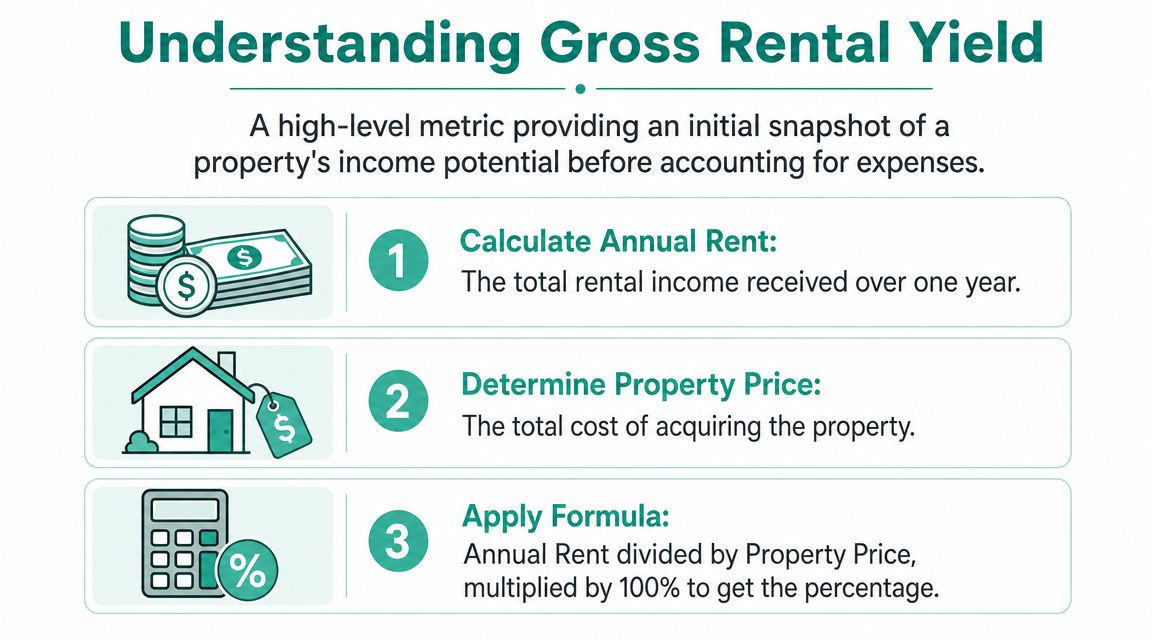
The first number to calculate is gross rental yield. It's the quick screen. It tells you whether a property deserves a deeper look.
According to Wise's explanation of how rental yield is calculated, a technically sound process starts in two stages. First calculate gross yield as annual rent divided by property value. Then move to net yield by subtracting annual operating expenses before dividing by the same value. That same guidance notes that 5% to 8% gross yield is often considered solid in many US markets, while also warning that vacation-rental and international markets can behave very differently.
The simple formula
The formula is straightforward:
Gross rental yield = annual rent ÷ property value
If you're calculating a long-term lease, annual rent usually means monthly rent × 12. If you're calculating a vacation rental, don't jump to advertised nightly rates and assume they hold year-round. Gross yield still works as a first pass, but only if the income input is realistic.
Here's what that looks like in practice for a condo in Las Ballenas:
- Estimate the annual rent: Use actual lease income if it's a long-term rental, or a conservative annualized rental figure if it's a short-term property.
- Choose the property value carefully: Use one consistent base. Either the current market value or the purchase basis. Don't switch between them mid-analysis.
- Run the division: Annual rent divided by value gives the gross yield.
Why gross yield is only a filter
Gross yield helps you compare one property to another quickly. That's useful when you're screening condos in Playa Bonita against smaller units near Pueblo de los Pescadores, or contrasting a villa in Portillo with an apartment closer to town.
But gross yield is a headline number, not a decision number.
The biggest mistake at this stage is treating rent like pure profit. It isn't. Gross yield ignores management, repairs, insurance, taxes, vacancy, and the practical costs of operating a property from abroad.
Practical rule: Use gross yield to decide whether to continue the conversation. Use net yield to decide whether to buy.
There's another technical issue buyers often miss. Wise also notes that investors may calculate yield against total investment rather than only purchase price when closing costs or capital improvements are meaningful. In Las Terrenas, that matters. If you buy a unit and then spend heavily on furnishing, repairs, or upgrades before it can rent properly, using only the asking price can flatter the result.
Calculating Net Rental Yield What You Actually Earn
Net rental yield is the number that tells you whether the property works in practice.
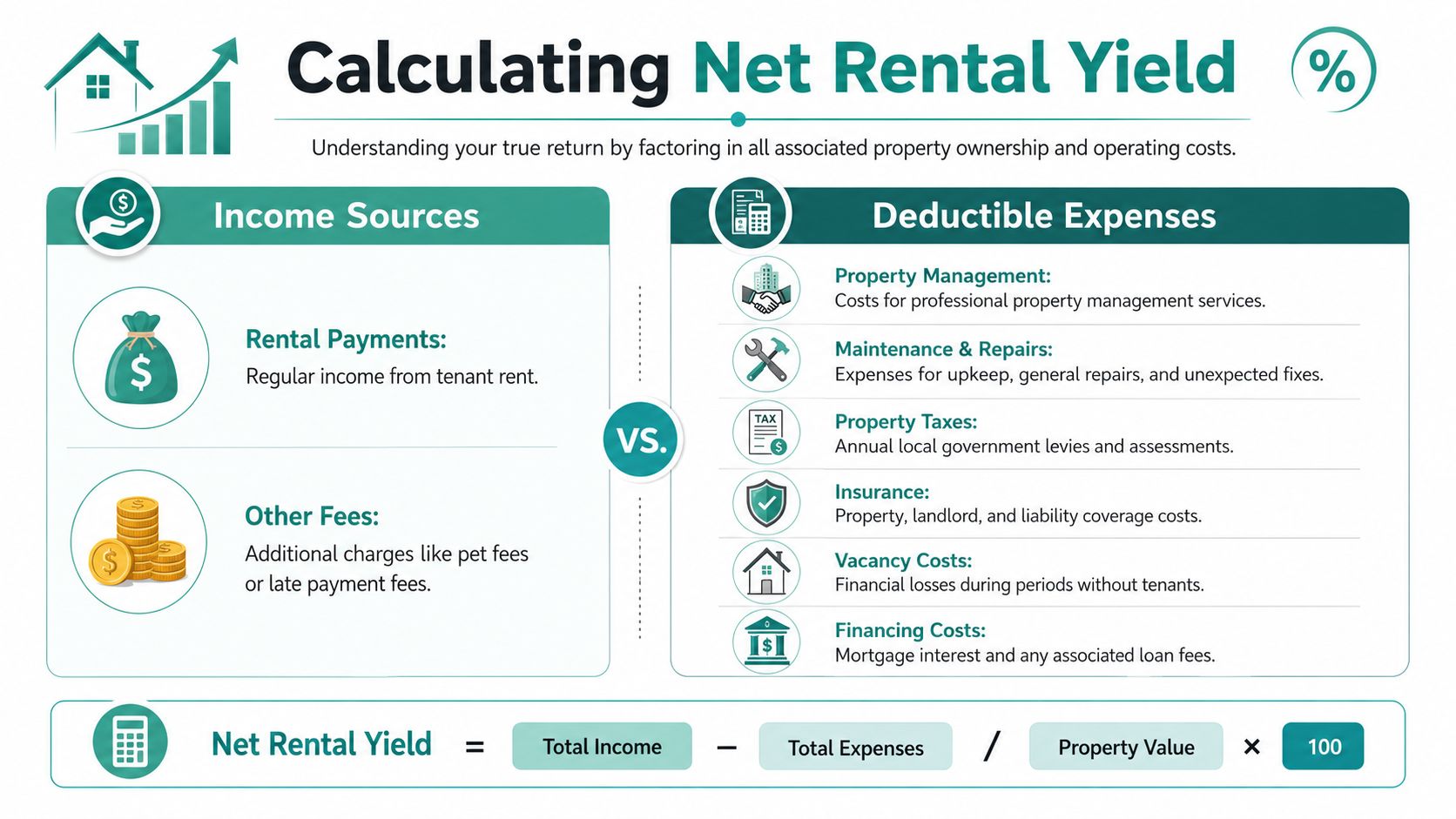
Gross yield can make almost any attractive vacation rental look promising. Net yield forces the property to carry the actual burden of ownership. That means annual income goes down by recurring operating costs before you divide by the value basis.
A more advanced approach comes from Landlord Studio's rental yield calculator guidance. It recommends building annual rental income from monthly rent × 12 or observed historical performance, then adjusting for vacancy and expenses such as management, repairs, insurance, and owner-paid utilities. It also stresses a point we agree with completely in Las Terrenas. A common analytical mistake is stopping at gross yield. The more investable measure is net yield, or a cap-rate-like view based on annual net operating income.
Which expenses belong in the calculation
Here are the expense categories we tell buyers to include before they trust a number:
- Property management: If you won't live in Las Terrenas full-time, management is usually operationally necessary, especially for short-term rentals.
- Maintenance and repairs: Salt air, humidity, pool systems, air conditioning, paint, and exterior wear all need regular attention.
- Insurance: This belongs in the annual operating line, not as an afterthought.
- Condo or community fees: Condos in Playa Bonita, Las Ballenas, or Portillo often carry recurring shared maintenance costs.
- Utilities paid by the owner: Many short-term rentals include electricity, internet, water, and sometimes gas.
- Vacancy allowance: No vacation rental books perfectly across the year.
- Cleaning and turnover costs: Particularly relevant for short stays.
- Local taxes and compliance-related operating costs: These depend on the asset and structure.
That list is why net yield gives a more honest picture. It asks what the property keeps, not what it collects.
How Las Terrenas changes the math
Las Terrenas is not one uniform rental market. Different micro-locations change both income and expense patterns.
A condo near Pueblo de los Pescadores may have strong guest appeal because walkability matters. A villa in Cosón may command better nightly pricing but depend more on strong management, transport coordination, and presentation. A property in El Limón can offer a different guest profile altogether, often tied more to privacy and nature than beach access.
Seasonality matters too. Rental performance tends to move with tourism rhythms, local holidays, air access, and weather preferences. That doesn't make the market weak. It means you need to annualize income from realized occupancy, not the best month on the calendar.
Here's a practical way to underwrite:
- Start with observed rent, not aspirational rent
- Apply a conservative occupancy assumption
- Subtract recurring costs before you celebrate the yield
- Stress-test for slow periods and repair-heavy months
Mid-analysis, it often helps to see how other investors structure the numbers inside digital tools. If you're comparing methods, PropLab's app reviews for investors can help you evaluate calculator apps that go beyond simplistic rent multipliers.
A short video can also help if you prefer to see the logic visually before building your own spreadsheet:
If the yield only works when everything goes right, the yield doesn't work.
A Worked Example Calculating Yield on a Las Terrenas Villa
Let's put the method into a realistic local example. Assume you're evaluating a three-bedroom villa with a private pool in the hills of Cosón. It photographs beautifully, has real vacation-rental appeal, and looks like the kind of property that could perform well with international guests.
The first instinct is usually to ask what nightly rate similar villas advertise. We'd rather start with the tougher question. What annual income is plausible once occupancy is treated realistically?
Start with income built from real occupancy
For this worked example, use a purchase price of $550,000. The annual rental income should not be built from the highest seasonal rate multiplied across the full year. The safer approach is the one discussed earlier from Landlord Studio. Use realized occupancy, then stress-test for vacancy and seasonal swings.
The publisher background for this article notes that Las Terrenas vacation rentals can achieve 75%+ occupancy in the right circumstances, but that figure should be treated as a market signal, not a guaranteed outcome for an individual property. A villa in Cosón may outperform if the management is strong, the product is well-positioned, and the owner invests in presentation. It may also underperform if the setup is weak.
So for underwriting, we'd do this in practice:
- Review comparable villas: Focus on properties with similar bedroom count, finish level, pool quality, and distance from the beach.
- Separate high-season and low-season demand: Don't let peak winter weeks define the whole year.
- Discount the asking story: If a seller provides projected income, compare it to actual booking behavior in the area.
The right income number is the one you can defend after a weak month, not just after a strong one.
If you want a structured tool for running these scenarios, our Las Terrenas real estate investment ROI calculator is useful for testing assumptions side by side.
Then strip out the operating costs
Now comes the part that decides whether the villa is attractive or only looks attractive.
A short-term villa in Cosón usually carries a broader expense load than a simpler long-term apartment. There's more exterior maintenance. Pool care matters. Garden care matters. Guest turnover matters. If the property is managed remotely, service quality matters even more because poor operations quickly show up in reviews, occupancy, and repair bills.
Below is the framework we'd use.
| Item | Amount (USD) |
|---|---|
| Purchase price | $550,000 |
| Annual gross rental income | Qualitative estimate based on comparable performance and realized occupancy |
| Property management | Qualitative operating expense |
| Pool and garden maintenance | Qualitative operating expense |
| Repairs and replacement reserve | Qualitative operating expense |
| Insurance | Qualitative operating expense |
| Utilities paid by owner | Qualitative operating expense |
| Vacancy allowance | Qualitative operating adjustment |
| Net operating income | Gross income minus annual operating expenses |
| Net rental yield | Net operating income divided by value basis |
This is deliberate. Without verified figures for all those line items, the right move is to keep the structure precise and the amounts qualitative rather than inventing “typical” numbers.
What matters is the sequence:
- Build annual income conservatively
- Subtract every recurring cost
- Divide the remaining income by the same value basis
- Check whether the result still works after conservative assumptions
In practice, many villas look excellent at the gross level and merely average at the net level. That isn't a reason to avoid them. It's a reason to price them correctly and align the investment with your strategy. A buyer who wants strong personal use, high guest appeal, and longer-term asset quality in Cosón may still prefer this profile over a smaller property with a cleaner spreadsheet.
Common Pitfalls and Why Yield Is Not the Only Metric
Most mistakes in yield analysis aren't mathematical. They're behavioral. Buyers use optimistic assumptions because optimistic assumptions make the deal easier to justify.
That's especially common in a market like Las Terrenas, where a property can be emotionally compelling on first visit. A beachfront terrace in Playa Bonita or a tropical villa near Cosón can make almost any spreadsheet feel more convincing than it really is.
The errors we see most often
These are the problems that distort yield most often:
- Using advertised rates as achieved income: A listing's top nightly rate is not the same as annual rent collected.
- Ignoring vacancy: Even strong properties have slower periods, canceled stays, or booking gaps.
- Leaving out owner-side costs: Insurance, maintenance, utilities, and management can materially change the result.
- Mixing purchase price with market value: Choose one basis and stay consistent.
- Forgetting setup spend: Furniture, equipment, and upgrades may be necessary before the property can perform properly.
For buyers who want a broader primer on return thinking before they finalize their assumptions, SM Elite's 2026 rental property guide is a useful external read because it places yield inside a wider investment framework.
Why a lower yield can still be the better buy
This is where new investors often need the sharpest correction. Yield is important, but it is not the whole investment.
As Wall Street Prep's rental yield overview points out, a lower-yielding property can outperform a higher-yielding one if appreciation, financing structure, or tax treatment is stronger. The reverse is also true. A high gross yield can still be a poor investment once expenses are counted.
That's highly relevant in Las Terrenas. A property in a prime pocket of Playa Bonita may show a less aggressive yield profile than a less established location, yet still make more strategic sense for a buyer who values resale liquidity, stronger long-term demand, and easier guest positioning. If you're considering a tourism-driven income strategy, reviewing the local vacation rental landscape in Las Terrenas helps put that trade-off into a market-specific context.
A property is not just an income stream. It's also an asset with a location, a resale profile, and a management burden.
Actionable Strategies to Improve Your Rental Yield
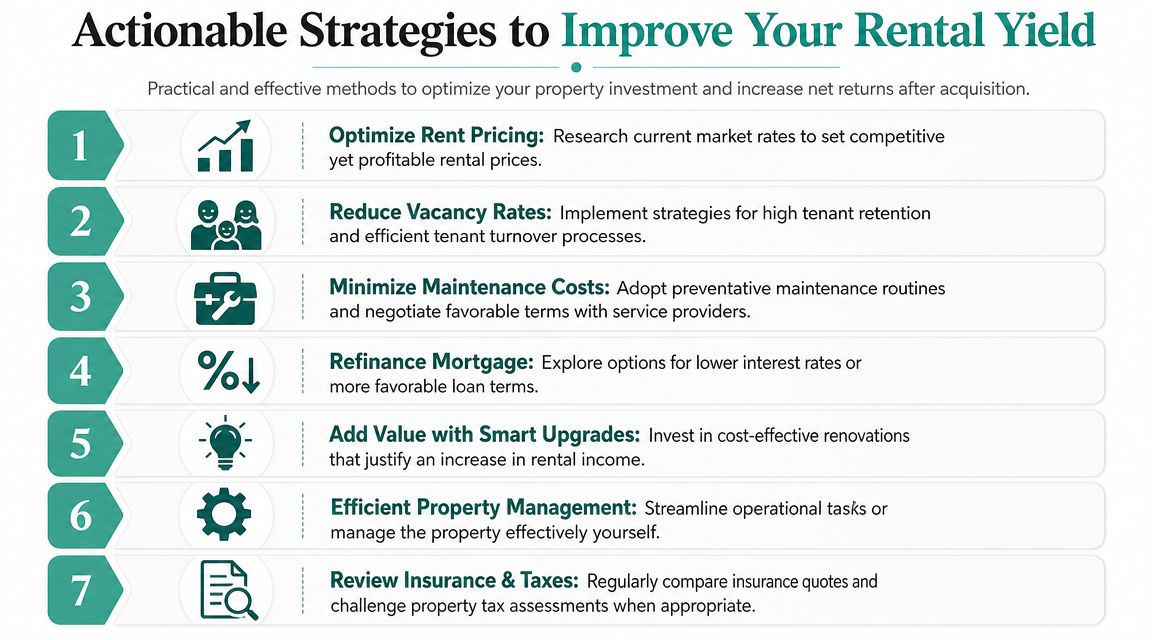
Once you own the property, the yield isn't fixed. Owners can improve both sides of the equation. Increase achievable income, protect occupancy, and control avoidable costs.
Improve revenue without guessing
In Las Terrenas, small operational decisions often separate average-performing rentals from consistently booked ones.
- Price by season, not by ego: Peak periods in a beach market can support stronger rates, but shoulder periods need realism.
- Invest in better presentation: Professional photography, sharp descriptions, and a coherent guest experience usually do more than owners expect.
- Upgrade what guests notice: Outdoor dining, reliable internet, quality bedding, and usable shade often matter more than decorative spend.
- Match the property to the right renter: A family-friendly condo in Portillo should be marketed differently from a design-led couple's retreat in Playa Bonita.
Protect the net side of the equation
Revenue gets attention. Expense control protects the result.
- Use preventive maintenance: In a humid, coastal environment, deferred maintenance usually becomes more expensive maintenance.
- Standardize turnovers and supplier relationships: Reliable cleaners, pool technicians, and repair contacts reduce disruption.
- Track owner-paid utility creep: Utility leakage erodes net returns in short-term rentals.
- Choose management based on execution, not promises: If you're remote, the manager shapes the asset's performance.
For owners who want operational support after acquisition, vacation rental property management in Las Terrenas can make a measurable difference because strong local execution affects occupancy, guest satisfaction, and maintenance discipline. Atlantique Sud Real Estate often works with buyers to connect acquisition strategy with that post-purchase operating reality, which matters just as much as the purchase negotiation.
Your Questions About Las Terrenas Yields Answered
What counts as a good yield
A useful benchmark from mainstream guidance is that roughly 5% to 8% gross yield is generally considered solid in many US markets, as noted earlier from Wise. In Las Terrenas, treat that as orientation, not a verdict. Vacation-rental dynamics, local operating costs, location quality, and seasonality can push a property above or below that range without automatically making it good or bad.
What matters more is whether the yield survives conservative underwriting.
Short-term or long-term rental
Short-term rentals usually offer more upside, but they also create more work and more operating variability. Management intensity is higher. Turnovers are frequent. Reviews matter. Utilities often sit with the owner.
Long-term leases tend to be simpler. The trade-off is that they may deliver less flexibility and a different income profile. In areas with strong tourism appeal such as Playa Bonita, Las Ballenas, and Portillo, many investors prefer short-term strategy because it aligns with the local demand base. In other cases, especially for owners who want lower operational complexity, long-term can be the better fit.
How should you underwrite from abroad
Use actual performance where possible. If you don't have historical numbers, build from conservative assumptions rather than asking prices and best-case weeks.
Landlord Studio's guidance is especially useful here. It recommends annualizing rent using the realized occupancy rate rather than advertised nightly or monthly rates, then stress-testing the result for vacancy and seasonal swings before calculating yield. It also warns that stopping at gross yield is a common mistake, and we agree.
The practical checklist is short:
- Use a consistent value basis
- Build annual income from realistic occupancy
- Subtract recurring operating costs
- Pressure-test the result
- Judge the asset beyond yield alone
If you're comparing opportunities in Playa Bonita, Cosón, Portillo, El Limón, or closer to Pueblo de los Pescadores, the quality of the assumptions matters as much as the formula.
If you want a second set of eyes on a property before you buy, contact Atlantique Sud Real Estate for a personalized market consultation focused on realistic rental yield, local operating costs, and neighborhood-specific investment trade-offs in Las Terrenas.