

What Is Virtual Tour in Real Estate: A 2026 Explainer
A virtual tour in real estate is a digital, interactive property walkthrough that lets you explore a home remotely using 360-degree images or 3D views. It has become a standard part of modern property marketing, with the global virtual tour market estimated at USD 11.06 billion in 2024 and projected to reach USD 74.36 billion by 2030, while 95% of future buyers say they want to view a property online before visiting in person.
Searching for property in Las Terrenas from Miami, Montreal, Paris, or São Paulo often presents a familiar challenge. Photos can show a kitchen, a terrace, and a bedroom, but they often don't tell you how the home flows. You can't tell whether the guest room sits beside the living area, whether the villa feels open or cramped, or whether that sea-view balcony is directly off the main suite or tucked behind the dining room.
That's where virtual tours matter. They help you pre-qualify a property before you spend time, money, and energy on calls, flights, or in-person showings. In a market like Las Terrenas, where many buyers are remote and many decisions begin online, virtual tours aren't a gimmick. They're one of the clearest ways to move from curiosity to serious due diligence.
Table of Contents
- Exploring a Property From Thousands of Miles Away
- Deconstructing the Modern Virtual Tour
- The Main Types of Virtual Tours You Will See
- Real Benefits for Buyers Sellers and Agents
- How Virtual Tours Change the Game in Las Terrenas
- Measuring the Success of a Virtual Tour
Exploring a Property From Thousands of Miles Away
An international buyer usually starts with a familiar frustration. You open a listing, scroll through attractive photos, and still have no clear idea whether the property works for your needs.
A beachfront condo in Portillo may look bright and polished. A hillside villa near El Limón may have stunning views. But if you can't understand the layout, the connection between indoor and outdoor areas, or the practical feel of the rooms, you're still guessing.
A virtual tour in real estate solves that specific problem. It gives you a digital, interactive walkthrough where you can move through the property remotely and inspect the relationship between spaces before deciding whether an in-person visit is worth it.
Why buyers now expect it
This shift isn't small. According to ShowingTime's overview of real estate virtual tours, the global virtual tour market was estimated at USD 11.06 billion in 2024 and is forecast to reach USD 74.36 billion by 2030, a projected 34.3% CAGR from 2025 to 2030. The same source reports that 95% of future buyers want to visit a property online before scheduling an in-person viewing.
That tells you something important. Buyers don't see online touring as a bonus anymore. They see it as part of the basic screening process.
Practical rule: Photos attract attention. A virtual tour helps you decide whether the property deserves your flight, your schedule, and your due diligence budget.
For remote investors, the logic is even clearer. If you're comparing several properties across different areas, being able to eliminate weak fits early saves time. That's one reason many investors also study remote-first transaction models, including InvestorMode's virtual wholesaling methods, because the same principle applies: better remote screening creates better decisions.
Virtual tours also connect naturally with the broader reality of owning property from abroad. If you're evaluating not only a purchase but also how the home would operate after closing, our article on managing rental property remotely is a useful next step.
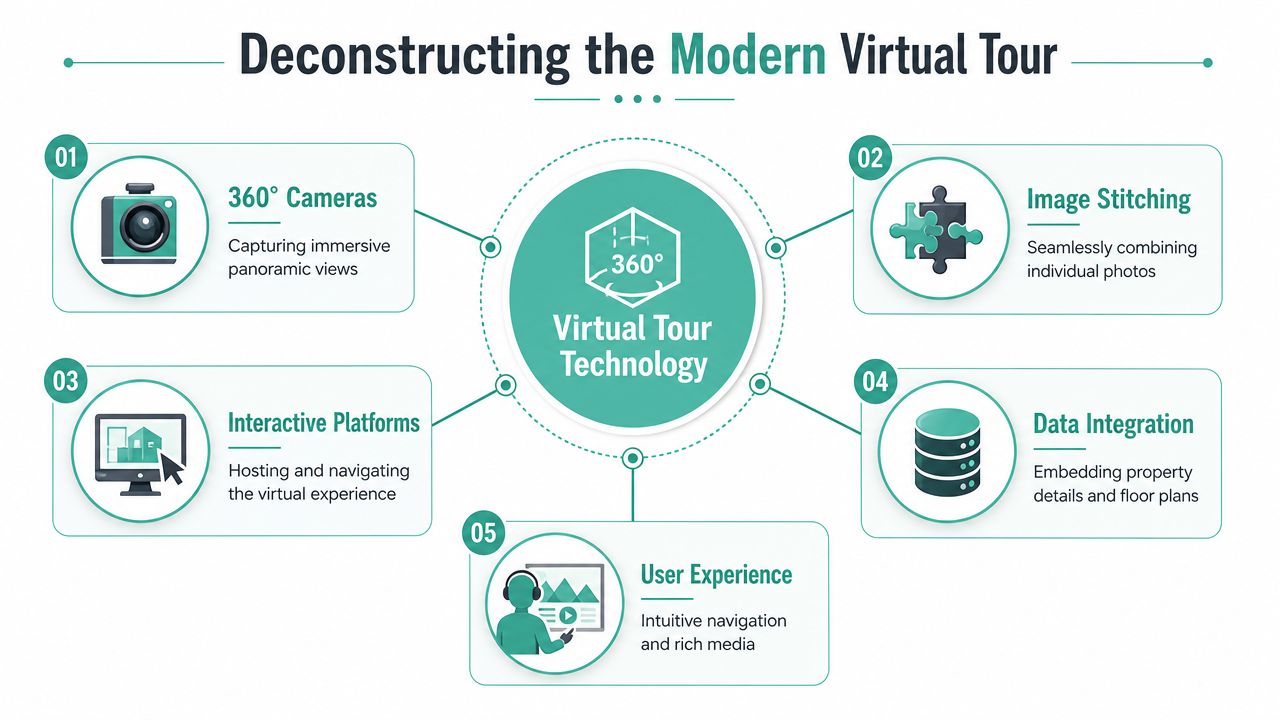
Deconstructing the Modern Virtual Tour
A lot of buyers think a virtual tour is just a video with a nicer label. It isn't.
A true virtual tour is interactive. You control where you look, where you move next, and how closely you inspect each room. That difference matters because buying decisions are rarely about one beautiful frame. They're about spatial understanding.
What makes it different from photos or video
Photos are selective. They show what the photographer chose to frame.
Video is guided. It shows what the editor decided to highlight, in the order they chose.
A virtual tour gives more control to the buyer. You can stop in the entry, look left toward the kitchen, turn around to check the staircase, and move room by room at your own pace.
Most modern tours are built from one of two workflows:
- 360-degree capture: A camera records panoramic views in each position, and the software links those positions into a navigable path.
- 3D capture: The system adds spatial modeling, so the tour reflects the geometry of the home more precisely and often supports extra tools.
That second category is where tours become more than marketing.
Why dimensional accuracy matters
According to GoiGuide's explanation of real estate virtual tours, a virtual tour is an interactive 360-degree or 3D digital walkthrough that lets buyers explore room to room. The same source notes that major platforms describe these tours as "dimensionally accurate", and some systems offer automated measurements for walls and room dimensions.
That phrase can sound technical, but the practical meaning is simple. You aren't just admiring the property. You're testing it.
Consider the questions buyers ask us all the time in Las Terrenas:
- Will the second bedroom fit two twins or a queen?
- Does the living room connect cleanly to the terrace, or is the transition awkward?
- Is the kitchen open to the social area, or visually separated?
- Does the guest suite feel private enough for short-term rental use?
A slideshow can't answer those very well. A better-built virtual tour often can.
If a buyer can understand room adjacency, circulation, and scale before a call, the conversation changes. It becomes less about basic orientation and more about fit, value, and next steps.
This is why the strongest virtual tours often include more than panoramic views. They may also feature floor plan overlays, measurement tools, or information hotspots that point out finishes, appliances, storage, or outdoor features.
The Main Types of Virtual Tours You Will See
Not every listing offers the same kind of tour. Some are highly interactive. Some are closer to guided media. If you're trying to understand what is virtual tour in real estate in practical terms, it helps to separate the formats you'll encounter.
360 photo tours
This is the format many buyers first meet. You click through a series of panoramic viewpoints and rotate your view inside each room.
It usually works well for straightforward homes, smaller condos, and listings where the goal is to help buyers understand basic layout without a heavy production setup. A 360 tour is often enough to answer early screening questions like whether the kitchen opens to the living room or whether the terrace is directly accessible from the main bedroom.
Its limitation is depth. You can explore, but the sense of precise spatial modeling may be lighter than in a full 3D system.
3D model tours
A 3D model tour goes further. It doesn't just connect panoramic stops. It builds a digital model of the property, which can create a stronger sense of structure and flow.
This format is especially useful for:
- Multi-level villas: You can understand how stairs, landings, and bedroom zones connect.
- Homes with outdoor living: Pools, decks, gardens, and covered terraces make more sense when the circulation between spaces is clear.
- Buyers doing remote due diligence: If you're abroad, anything that reduces layout ambiguity is valuable.
In Las Terrenas, this matters most for properties where circulation is part of the value. A villa in Cosón with several outdoor entertaining zones needs more than attractive still images. You want to know how guests move through the property.
If you want to see how this format appears in property marketing, browse examples under Matterport tours in Las Terrenas.
Video walkthroughs
A video walkthrough isn't usually a virtual tour in the strictest sense because you don't control the path. But buyers still lump it into the same category, and agents often use it for the same goal: helping remote prospects understand the home before a visit.
Video works best when the property's atmosphere matters as much as its geometry. A beachfront condo in Las Ballenas may benefit from video because motion can show how light enters the living room, how the terrace frames the view, and how the pool area feels in context.
Its weakness is the opposite of the 360 format. It can be emotionally engaging, but less interactive.
Virtual Tour Technology Comparison
| Tour Type | Level of Immersion | User Control | Best For |
|---|---|---|---|
| 360 Photo Tour | Moderate | High | Condos, simple layouts, early screening |
| 3D Model Tour | High | High | Villas, multi-level homes, remote due diligence |
| Video Walkthrough | Moderate | Low | Lifestyle presentation, view properties, emotional appeal |
A good listing doesn't always need the most complex format. It needs the format that answers the buyer's real questions.
In practice, the best choice depends on the property. If layout is the issue, 3D usually wins. If mood and setting are the priority, video can carry more weight. If you want a practical middle ground, 360 tours do a lot of work with less friction.
Real Benefits for Buyers Sellers and Agents
The test isn't whether a virtual tour looks modern. It's whether it improves decisions.
According to the National Association of Realtors article on creating a real estate virtual tour, the practical ROI question is whether virtual tours improve buyer quality or just increase clicks. That same source makes the point clearly: they work as a 24/7 open house, but their main value is for remote and international buyers and for pre-qualifying interest before in-person visits, not as a substitute for accurate measurement or neighborhood experience.
That matches what we see in real transactions.
For buyers
If you're abroad, a virtual tour helps you sort properties into three groups very quickly:
- Worth deeper review
- Maybe, but with questions
- Not a fit
That sounds simple, but it changes the entire search process. Instead of booking viewings based on polished photography alone, you arrive with a shortlist that already fits your layout, use, and lifestyle criteria.
Buyers looking at rental potential often benefit even more. A tour can reveal whether a condo feels practical for guests, whether bedrooms have enough separation, and whether common areas support the type of stay you have in mind. That becomes even more relevant when evaluating vacation rental property management options after purchase.
For sellers
A seller's biggest hidden cost is often not marketing spend. It's wasted attention from people who were never a real fit.
Virtual tours help reduce that problem because they make the home's strengths and limitations visible earlier. A serious buyer can self-screen before asking for a showing. That means fewer low-intent inquiries and more conversations with people who already understand the basics of the property.
What sellers need to hear: A virtual tour shouldn't hide flaws. It should reveal the property honestly enough to attract the right audience.
That honesty matters in a market with many remote inquiries. If the layout is unusual, a good tour clarifies it. If the outdoor space is the main selling point, the tour should make that obvious.
For agents
For agents, virtual tours improve the quality of conversations. Instead of spending the first twenty minutes explaining where the kitchen sits relative to the terrace, we can discuss value, renovation questions, rental use, or title and closing details.
A short video can also help buyers understand how these tools are used in real property marketing:
At Atlantique Sud Real Estate, we use visual assets like video walkthroughs and listing media to help remote buyers narrow choices before committing to in-person visits. That's useful, but it never replaces on-site due diligence, measurements, or local context.
How Virtual Tours Change the Game in Las Terrenas
Las Terrenas is the kind of market where virtual tours make immediate practical sense. A large share of interest comes from people who don't live here full time, and many buyers start with only a limited visit window.
Why remote screening matters here
A buyer considering a condo near Playa Bonita usually isn't comparing just one property. They're comparing neighborhoods, beach access, building style, rental use, and maintenance realities. Photos rarely help enough with that first filter.
The same goes for a villa in Cosón. Two homes may both look impressive online, but the feel can be very different once you understand circulation, privacy, guest access, and the connection between indoor living and the pool area.
In Las Terrenas, distance doesn't just separate buyers from properties. It separates them from context. A good virtual tour narrows that gap.
What this looks like in local neighborhoods
A few local examples make the value clearer.
In Portillo, condo buyers often want to know whether the unit feels compact and efficient or whether it feels segmented. A virtual tour helps them judge that before they fly in.
In Playa Bonita, buyers often care about indoor-outdoor flow. If the terrace is the heart of the property, the tour should make that obvious.
In El Limón, hillside homes can be more complex. Elevation changes, split levels, detached guest areas, and outdoor circulation matter more than one hero photo.
In Pueblo de los Pescadores, a buyer may care less about room count and more about how the property connects to walkability, nightlife, and short-stay appeal. A tour won't replace a neighborhood visit, but it can show whether the unit itself supports that lifestyle.
For international investors, this changes the process from broad browsing to targeted due diligence. Instead of landing in Las Terrenas with ten uncertain options, you arrive with a shorter list that already fits your strategy.
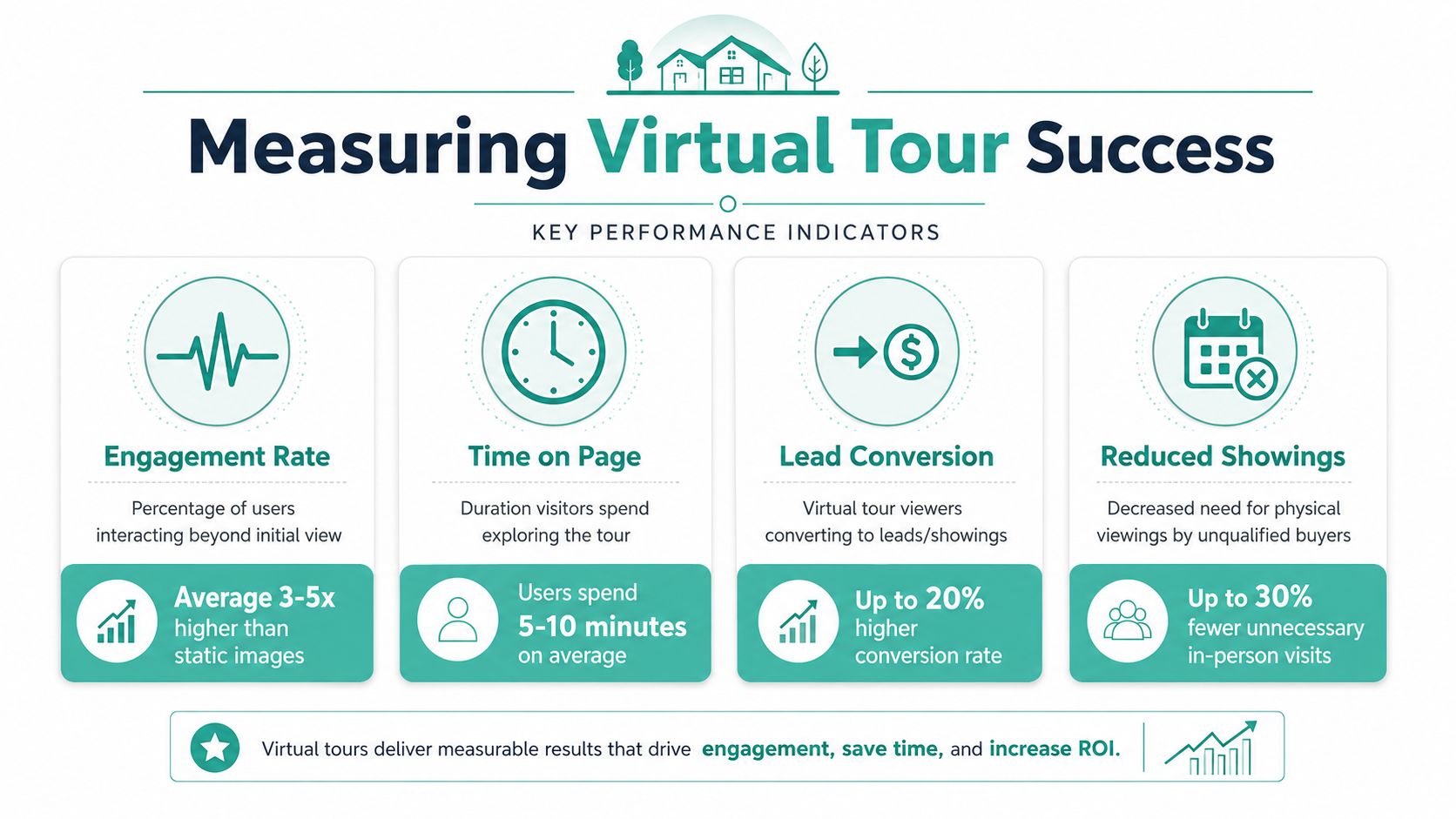
Measuring the Success of a Virtual Tour
The best way to judge a virtual tour isn't by asking whether people clicked on it. The better question is whether it improved the quality of the next action.
What to measure in practice
In day-to-day marketing, the useful indicators are usually qualitative unless your listing platform provides detailed analytics.
Look for signs like:
- Longer engagement: Buyers spend time exploring instead of bouncing after the first image.
- Better questions: Inquiries move beyond basics and focus on fit, condition, use, or next steps.
- Cleaner showing schedules: Fewer in-person visits come from people who misunderstood the layout.
- Stronger shortlist behavior: Remote buyers can narrow options before travel.
What the evidence actually says
The pricing question deserves honesty. A Harvard Business School review of evidence from 75,000 home sales found an "insignificant" impact on final prices after controlling for photos and descriptions, although earlier studies had suggested about a 1.1% sale-price increase when those factors were not controlled. The same source also cites separate industry data reporting that listings with virtual tours sold 31% quicker and for 9% more on average.
The clean takeaway isn't that virtual tours guarantee a higher price. They don't.
It's that their strongest value often shows up in showing efficiency, buyer qualification, and time on market. That's exactly why they matter so much for international buyers and sellers in Las Terrenas. They help everyone get serious faster.
If you're evaluating property from abroad and want listings that are easier to assess remotely, Atlantique Sud Real Estate can help you shortlist homes in Las Terrenas with a clearer view of layout, fit, and next-step due diligence.