Your Guide to Dominican Republic Taxes for Real Estate Investors
Investing in Las Terrenas real estate is an exhilarating prospect, but the first question on every savvy investor's mind is always about taxes. The great news is that the Dominican Republic's tax framework is designed to be welcoming and predictable, especially for foreign buyers like you.
As the leading real estate authority in Las Terrenas for over 25 years, we at Atlantique Sud have guided hundreds of international clients through this process. We understand that navigating a foreign tax system can seem daunting, but our deep local expertise turns complexity into clarity, empowering you to invest with total confidence.
Understanding the Core Taxes for Property Investors
Many potential buyers from North America and Europe worry about hidden fees or complicated paperwork. The reality is that the Dominican tax system is logical and, particularly with key incentives, highly favorable for property owners in tourism hubs like the Samaná Peninsula.
Let's demystify the key taxes you'll encounter. Getting a handle on these upfront will allow you to forecast your returns with precision.
Here's a snapshot of the taxes relevant to your real estate investment:
| Tax Type | What It Is | Standard Rate | Who It Affects |
|---|---|---|---|
| Property Transfer Tax | A one-time tax paid upon closing to transfer the title to your name. | 3% of the property's registered value. | All buyers at the time of purchase. |
| Real Estate Property Tax (IPI) | An annual tax on the value of your real estate holdings. | 1% on the value above a generous exemption (currently ~$177,000 USD). | Property owners whose assets exceed the exemption threshold. |
| Rental Income Tax | A tax on the gross income generated from renting out your property. | A 27% withholding tax for non-residents. | Investors who earn rental income. |
| Capital Gains Tax | A tax on the net profit you make when you sell your property. | 27% on the net gain. | Sellers who realize a profit on their property sale. |
Understanding these is step one. The crucial next step is leveraging powerful legal incentives, like the CONFOTUR law, to minimize or even completely eliminate some of them.
At Atlantique Sud, our mission is to make this process transparent. A well-informed investor is a successful one. We turn potential tax concerns into a clear, manageable part of your investment strategy, ensuring there are no surprises.
With our guidance, you’ll quickly see that Dominican Republic taxes aren't a barrier—they're simply a clear path to navigate on your way to a profitable Caribbean investment.
Navigating Property and Transfer Taxes
When you acquire property in Las Terrenas, two primary taxes come into play immediately. One is a one-time closing cost, and the other is an annual expense to factor into your budget.
The first you'll encounter is the Property Transfer Tax. This is a 3% tax based on the government-appraised value of the property, paid once at closing to officially transfer the title deed into your name. This is a critical step; without it, the property legally remains with the seller. Our team ensures this is handled flawlessly.
This infographic provides a clear overview of the taxes involved throughout the lifecycle of your investment.
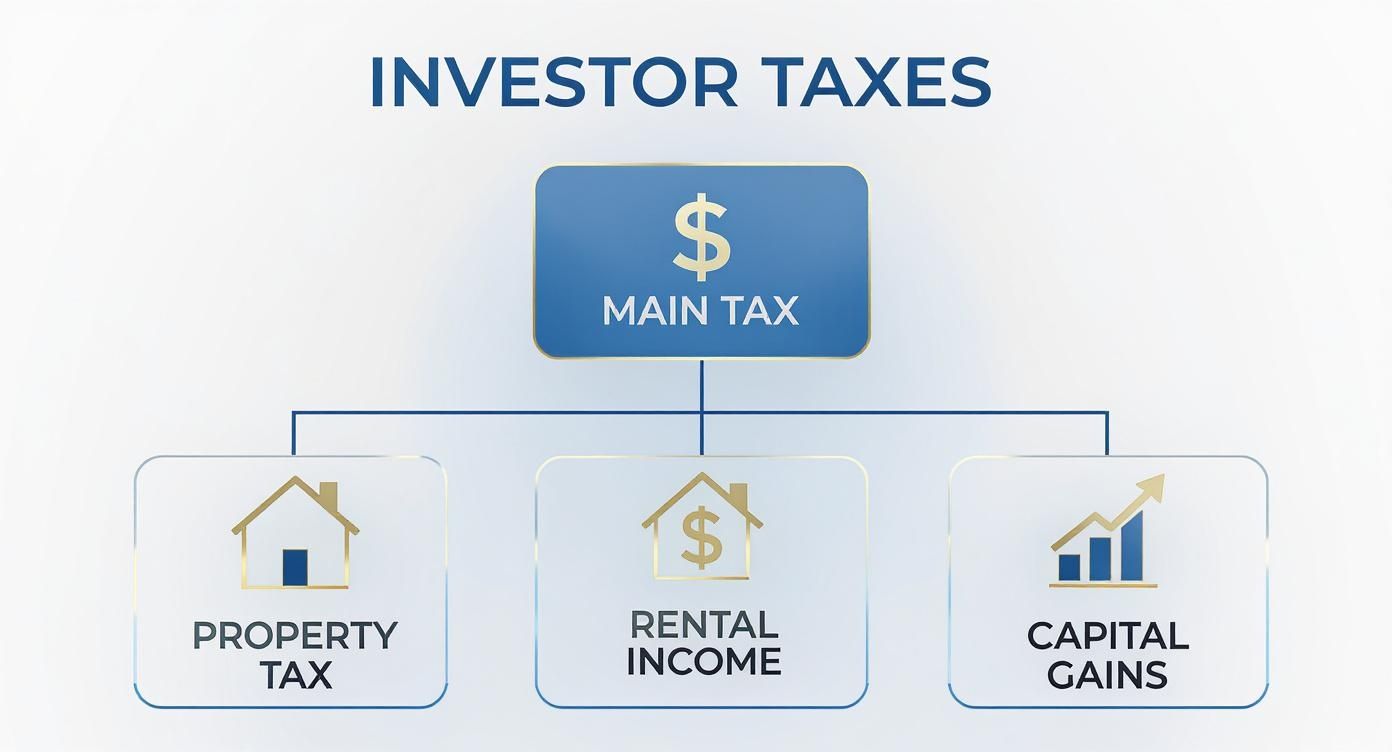
From purchase to ownership to sale, each phase has distinct tax implications that we help you plan for.
The Annual Real Estate Property Tax (IPI)
Once you're the official owner, your focus shifts to the annual Real Estate Property Tax, known locally as IPI (Impuesto al Patrimonio Inmobiliario). This is where the Dominican tax system reveals its investor-friendly design.
The IPI is not applied to the full value of your property. For 2024, the government provides a generous exemption on the first RD$9,860,649.00 (approximately $177,000 USD) of your property's value. You only pay the 1% tax on the value exceeding this threshold. This means many affordable condos and smaller homes are completely exempt from annual property tax.
Calculating Your IPI: A Real-World Example
Let's use a practical scenario. Imagine you purchase a beautiful villa in the desirable Playa Bonita neighborhood for $400,000 USD.
Here’s how your annual IPI would be calculated:
- Total Property Value: $400,000 USD
- IPI Exemption: -$177,000 USD
- Taxable Amount: $223,000 USD
- Annual Tax (1% of Taxable Amount): $2,230 USD
Even for a premium property, the annual tax liability remains very manageable. For more details, explore our guide on understanding property taxes in the Dominican Republic.
Individuals vs. Corporations: A Key Strategic Choice
Here’s a crucial detail for any serious investor: the $177,000 USD IPI exemption only applies to properties held in an individual's name.
If a property is held by a corporation, the 1% IPI applies to the full value, with no exemption. While this may seem like a downside, corporate ownership offers distinct advantages, including liability protection and simplified asset transfers, which can be essential for certain investment strategies.
The choice between individual and corporate ownership is one of the most critical decisions you'll make. It directly impacts your tax liability and long-term financial planning. We always advise consulting with a local attorney to determine the optimal structure for your specific goals.
At Atlantique Sud, we connect our clients with trusted legal experts specializing in Dominican real estate law. They help you weigh the pros and cons, ensuring your ownership structure is perfectly aligned with your objectives.
Maximizing Returns With CONFOTUR Tax Exemptions
While understanding standard taxes is essential, the secret to supercharging your investment returns in the Dominican Republic is the CONFOTUR law (No. 158-01). For international investors, this isn't just a minor benefit—it's a financial game-changer that can eliminate your property tax burden for 15 years.
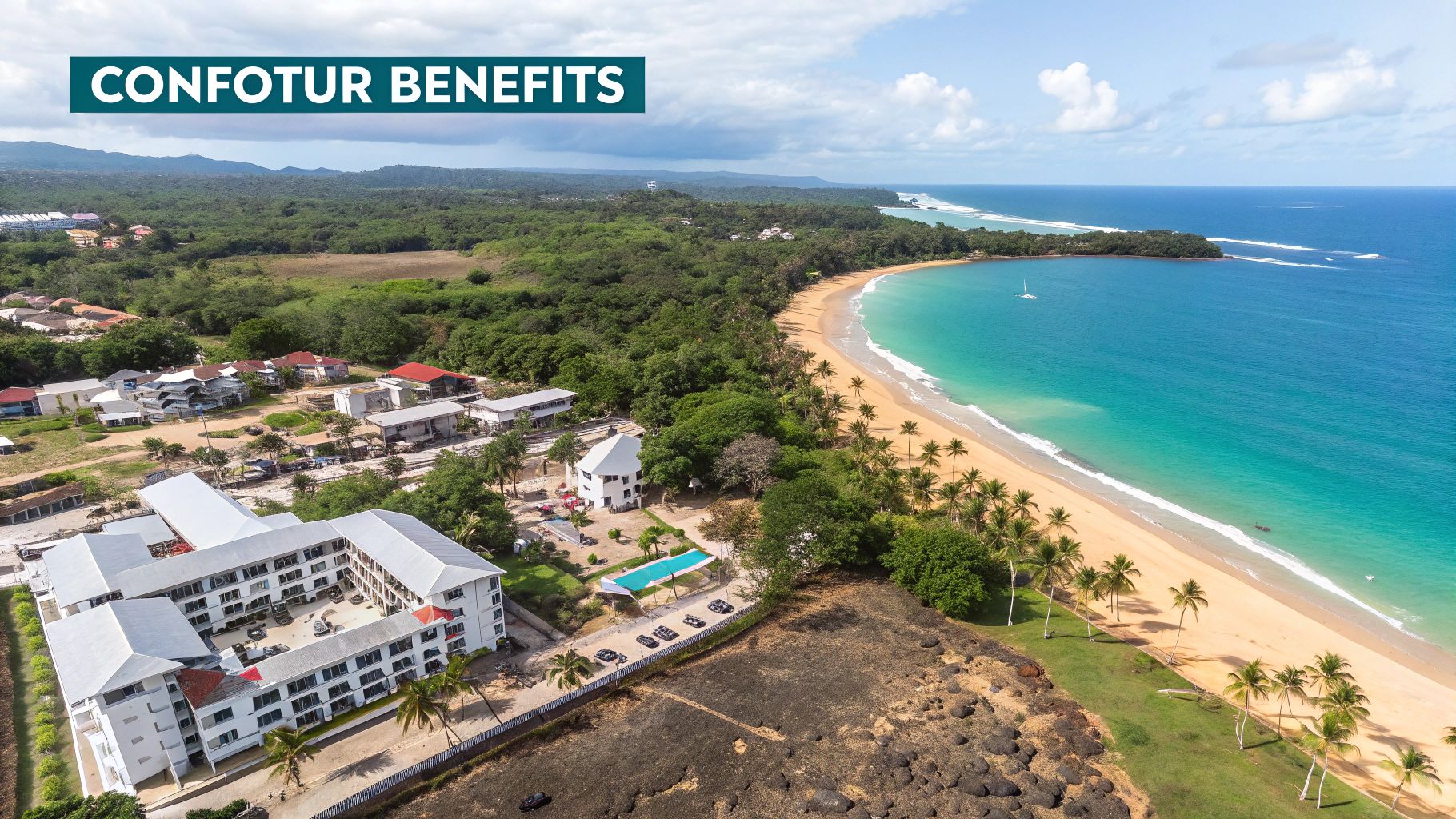
This law was specifically created to incentivize tourism development in key regions, and fortunately, Las Terrenas and the entire Samaná Peninsula are designated CONFOTUR zones. When you buy a qualifying property, you receive a 15-year tax exemption that dramatically boosts your net returns.
This incentive turns a good investment into a great one by wiping out the two primary property taxes.
The Two Pillars of CONFOTUR Benefits
A CONFOTUR-certified property grants you two powerful exemptions:
- Exemption from the 3% Property Transfer Tax: This one-time fee is completely waived. On a $500,000 USD property, that’s an immediate saving of $15,000 USD at closing.
- Exemption from the 1% Annual Property Tax (IPI): You pay zero annual property tax for a full 15 years. On a $400,000 USD villa, this saves you $2,230 USD every year, totaling over $33,000 USD in savings.
These significant savings accelerate your return on investment and increase cash flow from rental income.
At Atlantique Sud, we specialize in identifying properties with these powerful tax advantages. The CONFOTUR law is the single most effective tool for maximizing profitability in this market, pushing rental yields into the highly attractive 5.6% to 7.7% range.
By eliminating major tax burdens, more of your rental income flows directly to your bottom line.
Identifying CONFOTUR-Certified Properties in Las Terrenas
So, how do you secure one of these tax-advantaged properties? The benefits are granted to specific real estate projects during development, meaning not every property qualifies. It is almost exclusively new, well-planned communities that have undergone the official certification process.
As local market leaders for over two decades, we have our finger on the pulse of every new project in sought-after areas like Playa Bonita, Playa Cosón, and Loma Bonita. We know exactly which new luxury condo developments and modern villa communities come with these valuable exemptions. These properties offer not just premier amenities but also a built-in financial advantage that older properties cannot match.
Your Strategy for Tax-Advantaged Investing
Securing a CONFOTUR property requires deep local knowledge and a proactive approach. The process involves verifying the developer's certification and ensuring the exemption is correctly applied to your title at purchase—a process you shouldn't navigate alone.
Here are the actionable steps we guide our clients through:
- Targeted Property Search: We filter our exclusive listings to showcase premier properties carrying the 15-year tax exemption.
- Developer Vetting: We verify that the developer’s CONFOTUR status is current and fully compliant with Dominican law.
- Legal Verification: Our trusted legal partners meticulously review all documents to ensure your tax exemptions are legally binding and correctly registered.
This focused approach removes the guesswork and ensures you capitalize on the full financial power of the CONFOTUR law. For a deeper look, read our complete guide on investing in tax-free real estate with CONFOTUR Law.
Understanding Rental Income and Capital Gains
Once you've secured your property, the goal is to make it work for you. A successful Las Terrenas investment not only appreciates in value but also generates a steady income stream. Understanding your tax obligations on these returns is key to calculating your true profitability.
For non-resident foreign investors, the tax structure on income is refreshingly simple. You only need to focus on two areas: the tax on rental earnings and the tax on your profit when you sell.
Tax on Your Rental Income
Income generated from renting your property is subject to a 27% withholding tax for non-residents. While the rate may seem high, the collection process is designed for your convenience. You are not required to file complex returns with the Dominican tax authority (DGII) from abroad.
Instead, your local property management company handles everything seamlessly:
- They collect rental payments from guests.
- They deduct their management fees and operating costs.
- Before wiring you the net profits, they withhold the 27% tax and remit it directly to the government on your behalf.
This system ensures full compliance with local laws without any administrative burden on you. Atlantique Sud connects our clients with Las Terrenas' most reputable property managers who have perfected this process.
Calculating Your Capital Gains Tax
A smart investment strategy includes a clear exit plan. When you sell your property for a profit, that gain is subject to a 27% capital gains tax. Crucially, this tax applies only to your net gain, not the total sale price.
Understanding this calculation from day one is vital for projecting your investment's full lifecycle returns.
The principle is straightforward: you are taxed on the difference between your sale price and your original purchase price, adjusted for any capital improvements you've made. This ensures the tax is fair and applies only to the actual wealth your investment generated.
Let's walk through an example. For more detail, see our complete guide on what capital gains taxes are.
A Practical Calculation Example
Imagine you purchased a beachfront condo in Playa Popy a few years ago.
- Original Purchase Price: $300,000 USD (This is your "cost basis").
- Capital Improvements: You invested $25,000 USD in major upgrades (e.g., a new kitchen). Your adjusted cost basis is now $325,000 USD.
- Final Sale Price: You sell the property for $450,000 USD.
- Calculating Net Gain:
- $450,000 (Sale Price) – $325,000 (Adjusted Cost Basis) = $125,000 USD (Net Gain)
- Determining the Tax:
- $125,000 (Net Gain) x 0.27 = $33,750 USD (Capital Gains Tax Owed)
This predictable formula allows for effective long-term planning, giving you confidence in your financial decisions.
The Bigger Picture of the DR's Fiscal Strategy
To fully appreciate your investment's potential, it’s helpful to understand the Dominican Republic's broader economic strategy. The tax system is not arbitrary; it's a carefully designed framework to attract foreign capital and stimulate economic growth, particularly in the vital tourism sector.
The country’s fiscal policy relies more on consumption taxes (like VAT) than on direct taxes on property or income. This is a deliberate choice. Incentives like the CONFOTUR law are not just perks; they are core engines of the national economic policy, designed to make the DR a competitive and attractive destination for investment.
This long-term vision creates a stable and predictable environment for you. You can invest knowing that these powerful tax benefits are part of a sustainable national strategy.
Why Foreign Investment Is a Top Priority
The government's strategy is evident in its tax collection data. In 2023, the Dominican Republic’s tax-to-GDP ratio was just 14.3%, well below the Latin American and Caribbean average of 21.3%. The value-added tax (ITBIS) alone accounts for over a third of all tax revenue.
This structure means that foreign direct investment in real estate and tourism is essential for economic health. It injects capital, creates jobs, and supports local businesses.
This bigger picture is crucial for investors. The tax incentives offered are not temporary loopholes but foundational pillars of the nation's economic policy. This ensures their stability and provides a reliable framework for your long-term financial planning.
Your investment in Las Terrenas real estate aligns perfectly with the country's strategic goals, adding another layer of security to your asset.
How This Should Shape Your Investment Strategy
This knowledge gives you a strategic advantage in the market. Instead of focusing solely on a property's price, you can evaluate its value within this favorable fiscal system.
Here’s how to use this context to your advantage:
- Prioritize CONFOTUR: Make finding a CONFOTUR-certified property your top priority to maximize tax efficiency.
- Invest with Long-Term Confidence: The government’s reliance on tourism means these incentives are built to last, giving you security in your 15-year tax holiday.
- Plan Smarter: A clear understanding of the tax structure enables better projections for rental income and your eventual exit strategy.
For a broader perspective on global financial planning, exploring strategies for tax efficiency and overcoming double taxation can offer valuable insights for international investors. With our 25+ years in Las Terrenas, we guide you not just to a beautiful home, but to an investment strategically positioned for long-term success.
Your Partner for Smart Investing in Las Terrenas
Navigating Dominican Republic taxes is a landscape that requires expert local guidance. This is where having the right team on the ground becomes your most valuable asset.
We've covered the key taxes and the game-changing benefits of CONFOTUR. The next step is applying this knowledge to achieve your specific investment goals.
At Atlantique Sud, we do more than just sell properties. We are your strategic partners, connecting you with a vetted network of legal and tax professionals who are experts in this field. With over 25+ years of dedicated experience in Las Terrenas, we have the relationships and firsthand knowledge to guide you seamlessly through every step, ensuring your purchase is structured for optimal tax efficiency from day one.
Understanding the Local Financial Landscape
Local knowledge is critical for a secure investment. While tax laws are clear, the Dominican Republic has faced challenges with compliance enforcement. Studies show significant tax evasion, as noted by risk analysts at Coface.
This highlights why working with established, reputable professionals is non-negotiable. Our vetted network ensures your transactions are handled with complete integrity and in full compliance with Dominican law, protecting your investment from these broader systemic issues.
Choosing the right team on the ground is the single most important decision you'll make. It’s the difference between a seamless, profitable investment and one filled with unnecessary complications.
Let our deep-rooted experience in the Samaná Peninsula work for you. We provide the strategic advice and trusted connections you need to invest with absolute confidence.
Your perfect, tax-advantaged property in paradise is within reach. Contact our team at Atlantique Sud today for a personalized consultation to discuss your investment strategy and explore exclusive listings in Las Terrenas.
Your Top Questions About DR Real Estate Taxes, Answered
Stepping into a new country's tax system can feel complex. To provide clarity, here are straightforward answers to the most common questions we hear from international investors looking at Las Terrenas real estate.
What's the main yearly property tax I should have on my radar?
The key annual tax is the Real Estate Property Tax, or IPI. It’s a 1% tax, but it only applies to the value of your property above a generous exemption threshold, which for 2024 is approximately $177,000 USD. This means many condos and smaller homes in Las Terrenas are fully exempt from this annual tax.
How exactly does the CONFOTUR Law save me money?
The CONFOTUR law is the most powerful financial tool for a real estate investor in the DR. If you buy a property in a certified tourism project like those in Las Terrenas, you receive a 15-year tax holiday from two major taxes:
- The 3% Property Transfer Tax paid at closing.
- The 1% annual IPI on your property's value.
This provides substantial upfront savings and eliminates your annual property tax bill for over a decade, directly boosting your net rental income.
Is it smarter to buy property as an individual or set up a corporation?
This depends entirely on your investment strategy. Buying as an individual is simpler and allows you to benefit from the $177,000 USD IPI exemption.
However, holding property within a Dominican corporation is often preferred by serious investors for liability protection and simplified estate planning or asset transfer.
We always recommend discussing your specific situation with a local real estate attorney. Atlantique Sud has a network of trusted legal experts specializing in structuring purchases for foreign buyers, and we are happy to connect you.
What taxes are involved when I rent out my property?
For non-resident owners, rental income is subject to a 27% withholding tax. The process is seamless, as your property management company handles it for you. They collect rent, remit the required tax to the government on your behalf, and transfer the net income to you.
Do I have to pay tax when I sell my property down the line?
Yes, any profit from the sale is subject to a 27% Capital Gains Tax. This tax is calculated on the net profit: the sale price minus your original purchase price plus the cost of any major capital improvements. Keeping detailed records of renovations is crucial for accurately calculating your net gain and ensuring you pay only the required tax.
Understanding the nuances of Dominican Republic taxes is the first step toward a smart, profitable investment. You don’t have to do it alone.
Let our 25+ years of on-the-ground experience in Las Terrenas work for you. The team at Atlantique Sud Real Estate is ready to provide personalized guidance, help you identify tax-advantaged properties, and connect you with our network of trusted legal and financial professionals.
Contact us today to schedule your consultation and start your journey to owning a piece of paradise.