

How to Calculate Real Estate ROI For Your Property in Las Terrenas
Investing in Las Terrenas real estate is an exciting venture, but how do you know if a property is truly a good deal? For international buyers and savvy investors, the true measure of success always comes down to one thing: the Return on Investment (ROI).
Essentially, ROI tells you how much profit you’re making compared to your initial investment. Mastering this calculation is the single most important skill for any property buyer looking to succeed in the Dominican Republic.
Understanding Your Real Estate Return on Investment
Here at Atlantique Sud, we’ve been the leading real estate authority in the Las Terrenas and Samaná Peninsula for over 25 years. Our experience with international clients shows that a clear grasp of ROI separates savvy investors from hopeful speculators. It’s about looking past simple arithmetic and digging into the two pillars of your returns: consistent rental income and long-term property appreciation.
Calculating your true ROI isn't a one-time calculation. Think of it as a dynamic measure of your property's performance. For investors in the Caribbean, this means factoring in everything—from rental yields, which can range from 5.6% to 7.7% in sought-after areas of Las Terrenas, to significant tax benefits from programs like the CONFOTUR law.
The Power of Appreciation
While rental income provides steady cash flow, appreciation is where serious wealth is built. This is the increase in your property's value over time, a critical component of your total ROI.
For perspective, a mature market like California saw residential real estate appreciate at an average annual rate of 6.77% for nearly four decades. Las Terrenas has its own unique market dynamics, driven by new infrastructure and growing international demand, underscoring the role appreciation plays in your total returns.
At Atlantique Sud, we help our clients analyze both income potential and appreciation forecasts. A beachfront condo in Playa Bonita, for example, will generate high rental demand immediately. In contrast, a villa in an emerging area like Loma de la Chiva might offer greater long-term growth potential. Our job is to match the right property to your financial goals.
Understanding these two components—income and appreciation—is your first big step. To build your foundational knowledge, we recommend reading our guide on real estate investment in the Dominican Republic. This will give you the confidence to forecast your returns like a professional.
The ROI Formulas That Actually Matter for Las Terrenas

Let's cut through the noise and talk numbers. When you're looking at property in Las Terrenas, it's easy to get lost in the beautiful views, but real confidence comes from knowing your investment is financially sound.
For any serious buyer, two core formulas truly matter. Get these right, and you'll have a crystal-clear picture of your potential returns.
The Cost Method: Your Big Picture ROI
First is the Cost Method. It’s the most straightforward way to see the total return you've made over your entire ownership period, especially after you sell. It measures your net profit against your initial investment.
Let's walk through a real-world Las Terrenas scenario. Imagine you purchase a stunning two-bedroom condo in Playa Popy for $350,000. After five years of solid rental income, you sell it for $450,000.
Here’s how the math breaks down:
- Investment Gain: $100,000 ($450,000 Sale Price – $350,000 Purchase Price)
- Total Investment: $350,000
- The Formula: (Investment Gain / Total Investment) x 100
- Your ROI: ($100,000 / $350,000) x 100 = 28.5%
This simple calculation shows the power of capital appreciation—a massive factor for building long-term wealth here in the Samaná Peninsula.
Comparing Rentals with Cap Rate
The second must-know formula is the Capitalization Rate, or Cap Rate. This is your secret weapon for comparing the income potential of different rental properties, regardless of their price.
The Cap Rate formula is simple but powerful: Net Operating Income (NOI) / Current Market Value. A higher Cap Rate almost always signals a better return from rental income alone.
Your Net Operating Income (NOI) is the key. It's your total annual rental income after paying all operating expenses—property management fees, insurance, maintenance, and HOA fees. It’s a pure measure of a property's ability to generate cash flow.
In Las Terrenas, a well-managed rental can easily achieve a Cap Rate between 5.6% and 7.7%. To make your life easier, it’s worth checking out online rental property ROI calculator tools, but remember they are only as good as the local data you input.
To get your ROI calculations spot on, you need to track several key financial details. Here’s a quick breakdown for a hypothetical villa in Las Terrenas.
Key Variables in Your ROI Calculation
| Component | Description | Example for a $350,000 Villa |
|---|---|---|
| Purchase Price | The total amount you paid for the property, including closing costs. | $350,000 |
| Annual Gross Rent | The total rental income collected over one year before any deductions. | $30,000 |
| Operating Expenses | All costs to run the property: management, insurance, taxes, maintenance. | $10,500 per year |
| Net Operating Income | Your annual gross rent minus your operating expenses. | $19,500 |
| Final Sale Price | The price you sell the property for at the end of your holding period. | $450,000 |
By keeping a close eye on these numbers, you move from hoping for a good investment to making a data-driven decision with confidence.
Accounting For Every Cost To Ensure Accuracy

One of the most common pitfalls for new investors is underestimating total costs. An overly optimistic expense sheet can turn what looks like a golden opportunity in the Dominican Republic into a source of frustration.
To calculate your real estate ROI with confidence, you must account for every single dollar. At Atlantique Sud, we walk our international clients through a comprehensive cost analysis to ensure there are no surprises. This means cataloging both one-time acquisition costs and ongoing operational expenses.
One-Time Acquisition Costs
These are the upfront expenses required to get the keys to your new property. Forgetting even one can throw off your initial investment figure.
- Legal & Notary Fees: Expect these to be around 1% to 1.5% of the property value. This covers critical due diligence and contract work by your Dominican lawyer.
- Title Transfer Tax: This is a one-time government tax of 3% of the property’s appraised value, paid to transfer the title into your name.
- Property-Specific Costs: Depending on the property, you could also face survey costs, utility connection fees, or initial furnishing expenses, especially for a new build.
Key Insight: Many properties in Las Terrenas qualify for the CONFOTUR Law. If your property has this certification, you are exempt from the 3% Title Transfer Tax and the annual 1% property tax (IPI) for up to 15 years. This provides a massive boost to your ROI from day one.
Ongoing Operational Expenses
These recurring costs determine how profitable your property will be year after year. Getting these numbers right is non-negotiable for a realistic ROI projection.
Think about expenses like insurance, utilities, regular maintenance, and property management fees, which typically fall between 10% to 20% of your gross rental income.
To keep a tight grip on all this, exploring efficient invoice management strategies for real estate can be a lifesaver. A crystal-clear understanding of your total investment and running costs is the foundation of a successful venture.
Forecasting Your Income and Appreciation Potential

Your ultimate success boils down to two things: how much rental income it generates and how much its value grows. Here at Atlantique Sud, we use 25 years of local market data to give our clients realistic, number-driven projections. Before any serious investor moves forward, conducting a thorough feasibility study is a non-negotiable step.
In Las Terrenas, investors consistently achieve strong rental yields. Well-managed properties often pull in 5.6% to 7.7%. This isn't luck; it's fueled by powerful economic drivers like sustained tourism growth and major infrastructure upgrades, such as the expansion of El Catey International Airport (AZS), which constantly bring new visitors to the Samaná Peninsula.
Pinpointing High-Growth Areas
While strong yields provide steady cash flow, appreciation builds substantial wealth. This requires a deep understanding of local economic conditions, population trends, and housing demand.
At Atlantique Sud, our on-the-ground experience allows us to identify neighborhoods poised for maximum growth. We analyze historical appreciation rates in coveted areas like Playa Bonita and Playa Cosón to guide clients toward properties with the highest potential. For instance, a new condo in a secure development might cost between $250,000-$400,000, while a luxury villa with ocean views can range from $700,000 to over $2 million.
This hyper-local knowledge turns a good investment into a great one. It’s about looking beyond today’s numbers to forecast tomorrow’s value.
If you want to dig deeper, check out our guide on how to evaluate the rental potential of your property in the Dominican Republic.
Let's break down how a real investment scenario plays out in Las Terrenas. This is precisely how we walk our clients at Atlantique Sud through a potential purchase, building a clear financial picture.
Imagine you’re eyeing a two-bedroom villa in a prime location like Playa Bonita. The purchase price is $350,000. But that’s not your total out-of-pocket cost. In the Dominican Republic, you must factor in closing costs, including the 3% title transfer tax and roughly 1% in legal fees (unless the property is CONFOTUR-exempt).
That adds another $14,000 to the pile, bringing your true initial investment to $364,000.
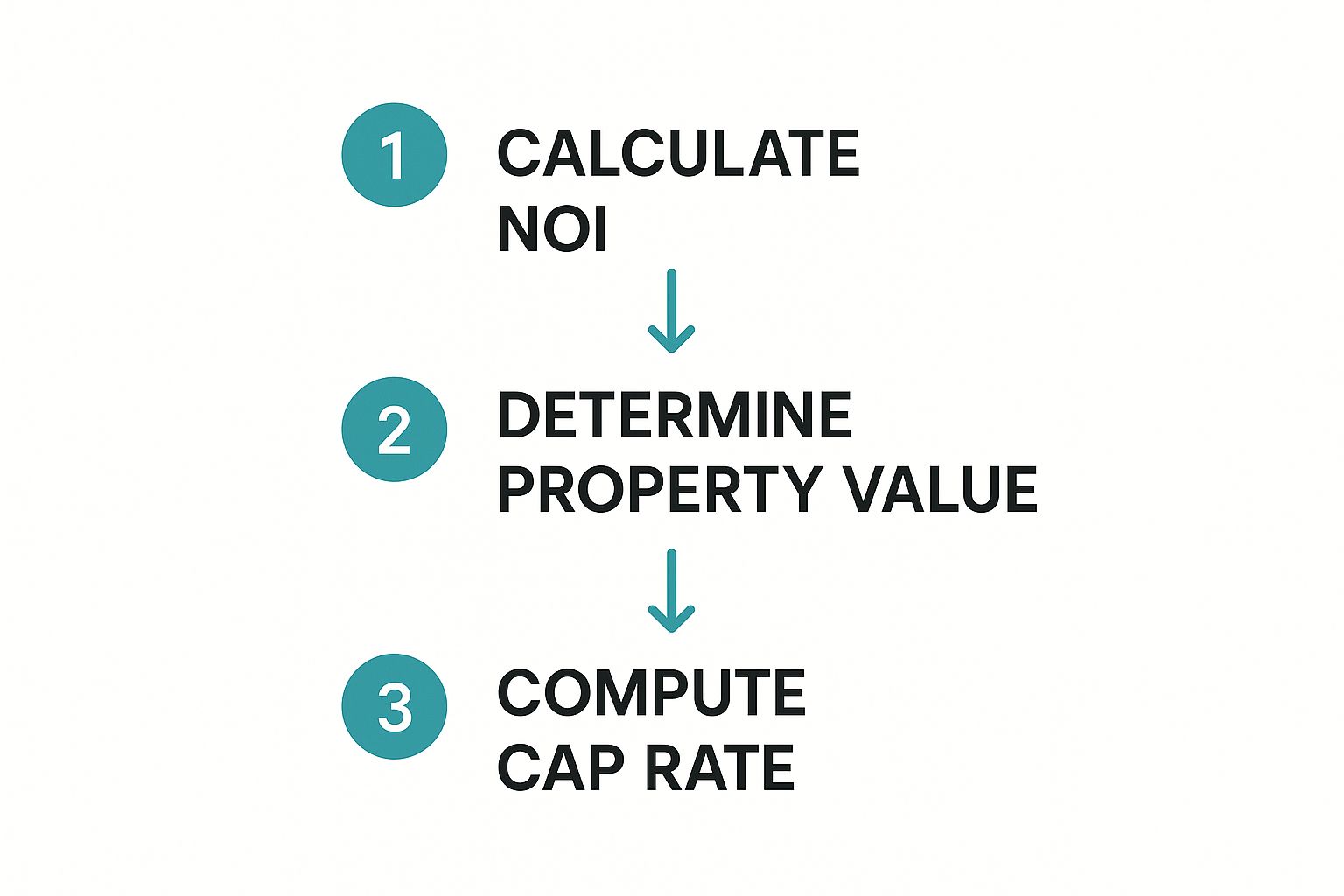
Projecting Income and Calculating Cap Rate
Next, we project what the property will earn. Based on current market rates and high-season demand, a conservative estimate for gross annual rent is around $30,000.
Of course, you subtract the costs to keep it running. Property management, insurance, and general maintenance can be estimated at about $10,500 for the year.
After expenses, you’re left with a Net Operating Income (NOI) of $19,500. With this, we can calculate the Cap Rate: $19,500 (NOI) / $350,000 (Property Value) = 5.6%. This percentage gives you a snapshot of the property's unleveraged annual return.
But what about long-term growth? Let's say you hold the villa for five years. With a reasonable 4% annual appreciation, that $350,000 villa could be worth around $425,000 when you decide to sell.
This analysis, using real-world data from Las Terrenas, is the blueprint for a smart investment. It moves beyond the sticker price to show what your money is actually doing for you.
Partner with Local Experts to Maximize Your ROI
Knowing how to calculate ROI is a vital skill, but deep local knowledge turns a good investment into a great one. The formulas are only as good as the numbers you plug in. That's where on-the-ground expertise becomes your most valuable asset.
For over 25 years, Atlantique Sud has been the trusted guide for international investors in Las Terrenas. We don’t just handle transactions; we partner with our clients to build long-term investment strategies that align with their financial goals.
Our unique understanding of market trends, the fine points of CONFOTUR tax benefits, and which neighborhoods are poised for growth gives our clients a serious advantage. We provide the data, insights, and professional property management you need to turn your Caribbean dream into a profitable reality.
We know which areas are poised for growth, what rental rates are actually achievable, and how to navigate the Dominican Republic's legal landscape to protect your investment. Let our experience be your guide to finding a high-return property in one of the most dynamic markets in the Caribbean.
Ready to see how our expertise can boost your returns? Contact the Atlantique Sud team today for a personalized consultation and a handpicked list of high-potential properties in Las Terrenas.
Frequently Asked Questions (FAQ)
When digging into real estate numbers, a lot of questions pop up. It’s completely normal. Over the years, we've heard just about every question from international buyers trying to understand ROI in Las Terrenas.
Let's tackle some of the most common ones right now.
What’s a Good ROI for a Rental Property in Las Terrenas?
This is the big one. While every property is unique, a solid target for a well-run rental in Las Terrenas is a cash-on-cash return of 8% to 12% per year.
Can you do better? Absolutely. In prime locations like Playa Bonita or Portillo, with great management and high occupancy, those numbers can climb higher. The key is analyzing a specific property to forecast its potential accurately, which we help our clients do every day.
What's the Difference Between ROI and Cap Rate?
It's easy to mix these up, but they tell you different things. Think of the Cap Rate (Capitalization Rate) as a quick snapshot. It measures a property's potential yearly income against its purchase price, without factoring in loans. It’s perfect for comparing different properties to see which is the better income generator.
ROI (Return on Investment), on the other hand, is the full story. It’s a wider lens, looking at your total profit—including appreciation when you sell—relative to the actual cash you put in over your entire ownership period.
How Do Capital Gains Affect My Total ROI?
The profit you make from selling your property is a huge piece of the ROI puzzle. It's often where the biggest returns are realized, so understanding how it's taxed is critical.
To get a clear picture of how this works here in the Dominican Republic, we've put together a detailed guide. We highly recommend you read our post on what capital gains taxes are.
Common Questions About ROI in the Dominican Republic
To make things even clearer, here’s a quick-reference table addressing the most frequent inquiries we get from investors looking at property in Las Terrenas.
| Question | Answer |
|---|---|
| Is an 8-12% ROI realistic in Las Terrenas? | Yes, for a well-managed property. Prime locations and strong rental demand often push this figure higher. |
| Does ROI include appreciation? | Total ROI does, yes. It accounts for both your net rental income and your final profit from the sale of the property. |
| Should I focus more on Cap Rate or ROI? | Use Cap Rate for quick, initial comparisons between properties. Use ROI for a comprehensive analysis of a single investment over its entire life. |
| How do operating expenses impact ROI? | Heavily. Your ROI calculation must include all costs—maintenance, management fees, taxes, insurance—to be accurate. Underestimating them will inflate your expected return. |
| Are high-season rentals enough to hit my ROI target? | While the high season is crucial, a strong year-round rental strategy is key to maximizing your annual return and achieving a good ROI. |
Hopefully, this table helps clarify some of the key points you'll encounter as you explore investment opportunities in the Samana Peninsula.
At the end of the day, a successful investment hinges on accurate calculations and deep local insight. Here at Atlantique Sud Real Estate, we provide the expertise to ensure you make informed, profitable decisions in Las Terrenas.
Want to skip the manual math? Try our free Las Terrenas ROI Calculator — enter the purchase price and nightly rate to instantly see cap rate, cash flow and total return across pessimistic, standard and optimistic occupancy scenarios.
Ready to find your high-yield property in paradise? Contact us today for a personalized investment consultation.


