

Your Guide to the Cost to Build a House in the Dominican Republic in 2026
So, you’re dreaming of building a villa here, and the first question that pops into your head is always the same: what’s the final cost going to be? As Las Terrenas’ leading real estate agency for over 25 years, we can tell you it's the most common question we get from international investors.
Looking ahead to 2026, our on-the-ground analysis shows a stabilizing market. We project that a high-quality home in Las Terrenas will cost between $725 and $1,125 USD per square meter ($67 – $105 per square foot). For investors targeting luxury finishes, budgeting for the higher end of that range is key.
This forecast gives our clients a solid financial starting point for planning their slice of Caribbean paradise, whether it's a retirement home, a vacation rental, or a strategic addition to a global property portfolio.
Your 2026 Construction Cost Forecast in the Dominican Republic
Here at Atlantique Sud, we’ve spent over 25 years helping people build their dreams in Las Terrenas. We know better than anyone that a clear, realistic budget is the absolute foundation of a successful project. For our international buyers, knowing exactly what to expect is everything.
The good news? The Dominican Republic’s construction market is maturing. The wild price swings of recent years are calming down, pointing toward a much more predictable building environment for 2026.
This stability is a huge plus for anyone looking to build, from an expat designing their forever home in Playa Bonita to an investor developing a high-yield rental property in Portillo. But remember, a per-square-meter estimate is just the beginning. The final number will be shaped by a few key factors unique to building in the Caribbean.
Key Factors Influencing Your Budget
Getting a handle on these variables is the first step to managing your investment without surprises. Our deep local knowledge is your best asset here, helping you navigate the process and maximize the value of your investment.
- Quality of Finishes: This is the biggest driver of your final cost. High-end imported Italian tiles, custom German kitchens, and premium fixtures will naturally push your cost per square meter up. Locally sourced, high-quality materials, on the other hand, will keep things more grounded.
- Architectural Complexity: A simple, elegant design is more budget-friendly than a complex masterpiece with intricate rooflines or massive walls of glass. The more complex the dream, the higher the cost.
- Site Conditions: The land itself plays a huge role. Building on a sloped lot in the hills of Cosón will require more extensive foundation work than a flat piece of land near Playa Ballenas. This can add a significant amount to your initial budget.
- Material Sourcing: While labor costs here are refreshingly stable, material prices can fluctuate. The latest market analysis confirms baseline costs between $650 to $1,125 USD per square meter depending on quality. Smart project planning is critical to manage where your materials come from. You can read the full report on construction cost trends for a deeper dive.
To give you a clearer picture, here’s a quick breakdown of what you can expect for different quality levels here in Las Terrenas.
Projected 2026 Construction Costs in Las Terrenas (Per Square Meter)
This table is a handy reference for budgeting your new home construction, breaking down the costs by the level of quality and finishes you have in mind.
| Quality Level | Projected Cost Range (USD/m²) | Key Features |
|---|---|---|
| Standard | $650 – $850 | Local materials, solid construction, basic finishes, standard windows/doors. |
| Mid-Range | $850 – $1,000 | Mix of local/imported materials, upgraded kitchens/baths, better tile work. |
| Luxury | $1,000 – $1,125+ | High-end imported finishes, custom cabinetry, infinity pool, premium fixtures. |
These figures provide a solid baseline for your initial calculations. Every project is unique, but this framework helps set realistic expectations from day one.
As your local partner, Atlantique Sud connects you with a vetted network of architects and builders who are masters at balancing high-quality, hurricane-resistant construction with cost-effective sourcing strategies designed specifically for our tropical climate.
Building your dream home on the Samaná Peninsula is more than a fantasy—it’s an achievable goal for savvy investors. With a clear understanding of these projected costs, you’re in a great position to start planning. In the sections to come, we’ll break these costs down even further, giving you the insights you need to build with total confidence.
Decoding The Budget: A Detailed Line-Item Breakdown
A per-square-meter estimate is a fantastic starting point, but a truly successful project lives in the details. To get a real grip on your finances, you need to understand exactly where every dollar is going. This knowledge turns a broad guess into an actionable plan for building your dream home here in the Dominican Republic.
Let's move past the general numbers and get into the specifics of a typical construction budget in Las Terrenas. This breakdown will give you the confidence to have sharp, informed conversations with your architect and builder, ensuring you remain in control of your investment.
Foundational And Structural Costs
This is the skeleton of your home, and it naturally makes up a huge chunk of the budget. These aren't costs to compromise on; they ensure your property is safe and built to last, especially in our Caribbean climate.
- Site Preparation and Foundation (10-15% of total budget): This covers land clearing, excavation, and pouring the concrete foundation and the essential cistern (water tank). The cost here can swing depending on your lot's topography. A sloped property in the hills of El Limon will demand more groundwork than a flat parcel near Playa Ballenas.
- Structural Frame (15-20% of total budget): This includes the concrete columns, beams, and block work forming the walls. We build with reinforced concrete to stand strong against seismic activity and hurricane-force winds—it's the Dominican standard for resilience.
- Roofing (5-8% of total budget): The cost for your roof depends on your chosen materials. Options range from traditional clay tiles, which are classic and durable, to modern flat roof systems perfect for a rooftop terrace or solar panel installation.
Exterior And Interior Finishes
Once the structure is solid, it's time to bring your villa's personality to life. This is where your personal taste can significantly move the needle on the budget. High-end imported tiles from Italy cost more, but fantastic local options offer incredible quality and value.
The bar chart below gives a clear visual of our projected 2026 building costs, helping you see the budget difference between standard and high-quality finishes.
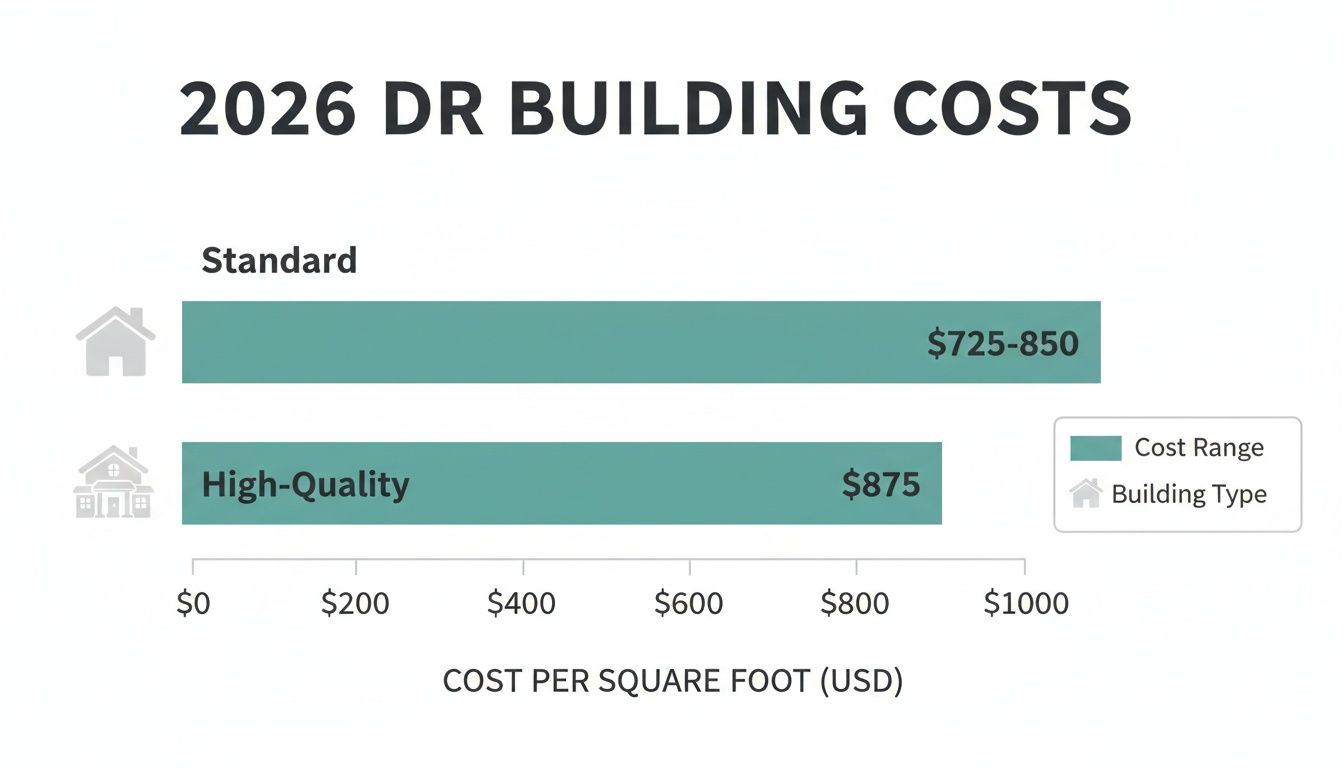
As you can see, even a high-quality build in Las Terrenas represents incredible value when compared to other luxury destinations in the Caribbean.
Professional Services And Permits
Think of these as the essential "soft costs" that ensure your project is legal, beautifully designed, and correctly managed. Cutting corners here is a classic mistake that almost always leads to bigger, more expensive headaches. No matter where you're building, knowing how to manage your budget in residential home design is a crucial skill.
- Architectural & Engineering Fees (5-10% of total budget): This includes design concepts, detailed blueprints, structural calculations, and the electrical/plumbing plans needed for permits.
- Permits and Government Fees (3-5% of total budget): These are mandatory fees for building licenses from the local municipality and, if applicable, the Ministry of Tourism.
- Project Management and Labour (20-25% of total budget): Labour is a major line item. This covers everyone from your general contractor to the skilled masons, electricians, and plumbers who physically bring your vision to life.
Expert Tip: Material selection is everything when you're up against tropical humidity and salt air. Making smart choices early on saves a fortune in future maintenance. For a deeper dive, check out our guide on choosing the right materials for your building project in the Dominican Republic.
This detailed breakdown demystifies the building process, giving you the clarity you need to move forward. When you understand these individual cost centers, you can allocate funds more effectively and ensure your project stays on track.
How Location And Property Type Drive Your Final Cost
In Las Terrenas, "location, location, location" isn't just about property value—it's a massive factor in your construction budget. The final price for your dream home in 2026 swings dramatically based not just on what you build, but exactly where you break ground.
A sprawling luxury villa on the sands of Playa Bonita will naturally have a higher build cost than a chic home in an up-and-coming neighborhood just minutes inland. It's a strategic choice that directly impacts your bottom line.
The same logic applies to property type. A custom single-family home designed for privacy will have a different cost structure than a multi-unit apartment building geared toward maximizing rental income.
Getting these nuances right is the first step in aligning your project with your financial goals, whether you're crafting a personal oasis or a high-performance investment property.
The Las Terrenas Advantage: A Regional Cost Comparison
When savvy international investors scan the Caribbean, they often compare Las Terrenas to other popular destinations. Major tourist hubs like Punta Cana come with steeper land prices and more standardized construction, often missing the unique character our clients seek.
This is where the Samaná Peninsula, especially Las Terrenas, shines. Here, you'll find construction costs are often 15-30% lower than in competing markets like Costa Rica or Tulum. That difference allows your investment to go much further, letting you achieve a higher standard of quality for your money.
Combine that cost efficiency with our powerful rental market, which yields 5.6-7.7% annually on average, and building here becomes a very compelling financial move.
At Atlantique Sud, we specialize in finding prime land opportunities—from the rolling hills of Cosón to the calm shores of Las Ballenas—that strike the perfect balance between breathtaking views, accessibility, and your budget.
Single-Family Homes vs. Multi-Unit Developments
The type of property you build is another huge cost driver. Recent market trends show a clear split in how costs are rising for different property types.
Interestingly, single-family detached homes have seen the sharpest cost increases, climbing by 7.3% annually as of mid-2025. In contrast, larger multi-family developments saw slower cost growth at just 2.9% over the same period. This suggests the economies of scale in bigger projects offer better cost stability for investors. You can explore in-depth property price history here.
This doesn't mean building a single-family villa isn't a fantastic investment. It just highlights a different cost profile.
- Single-Family Villa: Perfect for personal use, luxury vacation rentals, or high-end resale. Costs are more sensitive to custom finishes, but the potential for appreciation and premium rental rates is huge.
- Multi-Unit Property: An ideal choice for investors seeking diversified rental income. While the initial investment is larger, the per-unit construction cost is lower, and the slower rate of cost escalation provides greater budget predictability.
Choosing the right mix of location and property type is a critical first step. With over 25 years of experience in the Las Terrenas market, we give our clients the clarity to make the most profitable decisions.
From Permits to Professionals: Navigating the Building Process
A detailed budget is critical, but it's only as good as the process it supports. Successfully building in the Dominican Republic is a journey with clear stages. Here at Atlantique Sud, we've spent over 25 years guiding clients through this exact process, turning what seems complex into a clear path from blueprint to reality.
This journey starts long before the first shovel hits the ground. It begins with assembling your team—the trusted professionals who will bring your vision to life and safeguard your investment. This is arguably the single most important decision you'll make.
Assembling Your Local Dream Team
For anyone buying from abroad, having reliable experts on the ground isn't a luxury; it's non-negotiable. Your core team will be an architect, a contractor, and a real estate attorney. Each plays a distinct, vital role in keeping your project on schedule, on budget, and fully compliant with Dominican law.
The Architect: This is your visionary. A great local architect understands how to design for our tropical climate, maximizing airflow and building in hurricane-resistant features. They translate your ideas into the detailed blueprints needed for permits.
The Contractor (Constructor): This is your builder. A reputable contractor manages the entire on-site process, from hiring skilled labor to sourcing materials and overseeing daily progress. Their local experience is crucial for navigating supply chains.
The Attorney (Abogado): This is your legal shield. Your attorney will verify the property title (saneamiento), handle the purchase, and ensure every contract and permit is legally airtight. They protect your interests at every turn.
Over the years, we've built an extensive network of vetted professionals. We connect our clients exclusively with people who have a proven track record of delivering incredible results for international buyers. We’ve already done the due diligence, so you don’t have to.
Demystifying the Construction Timeline
Understanding the timeline helps manage expectations, especially when you’re overseeing a project from another country. While every build is unique, a typical custom home in Las Terrenas follows a predictable sequence.
Phase 1 Design and Planning (3-4 Months): This initial phase is a creative collaboration with your architect. You’ll finalize the layout, select materials, and sign off on the detailed construction plans.
Phase 2 Permitting (4-6 Months): Now comes the bureaucratic part. Your plans are submitted to the municipal planning office. Having an experienced architect who knows the system is invaluable. Our detailed guide offers more on obtaining building permits in the Dominican Republic.
Phase 3 Construction (8-14 Months): Once permits are approved, construction begins. This phase covers everything from laying the foundation and framing the structure to installing plumbing, electrical, and all interior and exterior finishes.
Phase 4 Final Inspections and Handover (1 Month): The home stretch. You'll do walkthroughs with your contractor to create a "punch list" of final fixes. After the final municipal inspection, you get your cédula de habitabilidad (certificate of occupancy) and the keys to your new home.
All told, the timeline from initial design to moving day typically falls between 12 to 24 months. By partnering with a team that prioritizes clear communication, you can confidently manage the whole process from anywhere in the world.
Making the Numbers Work: Financing and Returns on Your New Build
Building your dream home is a huge milestone, but it’s also a major financial undertaking. The key is to think of it less as an expense and more as a powerful asset. Your financing strategy needs to be as thoughtfully designed as your villa's floor plan, especially when you understand the incredible return on investment (ROI) waiting for you in the Dominican Republic’s market.
For most of our international clients, navigating financing is often a key concern. While local mortgages are available, interest rates currently sit around a steep 12.45%, which is why the vast majority of foreign buyers choose to build using their own capital. It simplifies the process, avoids hefty financing costs, and gives you total control. If you're curious about all the possibilities, our guide covers the entire landscape of financing real estate in the Dominican Republic.
From Construction Costs to Long-Term Gains
The real magic happens when you look past the initial budget and focus on what your property will generate. The residential construction market here is projected to hit USD 7.84 billion by 2026, a reflection of intense demand from foreign investors and a signal of fantastic long-term potential.
Here in Las Terrenas, that growth translates directly into impressive returns driven by two powerful financial engines:
- Serious Rental Income: The vacation rental market is on fire, with quality properties seeing 75%+ occupancy. A well-managed property can deliver net rental yields between 5.6% and 7.7%. For premium villas in prime spots like Playa Bonita, we’re seeing yields push into the 8-10% range.
- Strong Property Appreciation: The market has been posting property value gains of 15-20% recently. When you build from scratch, you're creating a modern home that's exactly what buyers are looking for, allowing you to capture that appreciation from day one.
The CONFOTUR Advantage: A Game-Changer for Your ROI
If there’s one financial tool every investor must know about, it’s the CONFOTUR law (Law 158-01). This tourism incentive law was designed to spur development in key areas, and for property owners, the benefits are massive.
Building within a CONFOTUR-approved development grants you a 15-year exemption from the most significant property taxes. This means you pay no annual 1% property tax (IPI) and no 3% title transfer tax on the first sale. Over 15 years, this tax holiday can save you tens of thousands of dollars, sending your net returns soaring.
Suddenly, your new villa isn't just a home; it's a high-performing, USD-denominated asset that’s incredibly tax-efficient. At Atlantique Sud, we specialize in identifying land and projects in these CONFOTUR zones to maximize our clients' financial upside.
Turning Your Build into a Smart Investment
The table below breaks down a realistic scenario for a custom-built villa in Las Terrenas. It shows how initial costs can transform into a lucrative investment property that generates strong rental income and appreciates in value, all while benefiting from CONFOTUR tax incentives.
Sample ROI Scenario for a Custom Villa in Las Terrenas
| Metric | Estimated Value (USD) | Notes |
|---|---|---|
| Total Construction Cost | $450,000 | For a 250 m² (2,690 sq ft) villa at $1,800/m². |
| Annual Gross Rental Income | $80,000 | Based on a conservative 65% occupancy at $340/night. |
| Annual Operating Expenses | $24,000 | Management (20%), utilities, maintenance, insurance. |
| Annual Net Rental Income | $56,000 | Gross Income minus Operating Expenses. |
| Net Rental Yield | 12.4% | (Net Rental Income / Total Cost) x 100. Exceptionally strong. |
| CONFOTUR Tax Savings (15 Yrs) | $67,500 | Avoids the annual 1% IPI on property value. |
| Estimated Appreciation (Year 1) | $67,500 | Based on a conservative 15% market appreciation. |
| Total Year 1 Return | $123,500 | Net Income + Appreciation. A powerful first-year performance. |
This example illustrates how building smart in the right location doesn't just get you a dream home—it creates a financial engine. The combination of high rental demand and significant tax savings makes a compelling case for building new in the Dominican Republic. Once complete, knowing how to accurately price a home for sale is critical to locking in your profits.
Thinking of Building in Paradise? Let's Make It Happen Together.
Building a home in another country can sound intimidating, but it doesn't have to be. With the right people on the ground here in Las Terrenas, that idea transforms into an incredible journey—one that ends with you holding the keys to not just a house, but a valuable asset in one of the Caribbean's hottest markets.
Getting a realistic handle on the projected 2026 cost to build is your starting point. From initial estimates to navigating local permits and choosing the right materials, every choice shapes your final budget and your return on investment. Success boils down to having a seasoned team guiding you through it all.
Your Local Partner on the Ground
This is where our 25+ years of experience at Atlantique Sud becomes your most powerful tool. We do more than just help people buy and sell properties; we build homes, we build relationships, and we ensure our clients’ visions come to life smoothly and profitably.
Our real value comes from connecting you to our exclusive, hand-picked network of Las Terrenas’ best architects, builders, and attorneys. Combining this network with our deep understanding of the local market is how we protect your investment and make the entire process feel effortless.
The path to building your dream villa is clear, but it’s not a road you should walk alone. The reality of managing a project from afar, dealing with local regulations, and sourcing quality materials demands a guide who has done it hundreds of times over.
Don’t leave your dream and your investment to chance. Get in touch with the Atlantique Sud team today to schedule a chat. Let’s talk about your vision and take that first, confident step toward building your own piece of paradise.
Your Questions Answered: Building in the Dominican Republic
Building your own home in the Caribbean is a dream for many, but it's natural to have questions. Drawing on our decades of on-the-ground experience in Las Terrenas, we've put together straight answers to the most common questions from our international clients. Our goal is to give you the clarity you need to move forward with total confidence.
How Long Does It Realistically Take to Build a House Here?
Patience and planning are your best friends. From initial design to the moment you’re handed the keys, a realistic timeframe is anywhere from 12 to 24 months.
First is the architectural design phase, which takes about 3-4 months. After that, navigating the local permitting process typically takes another 4-6 months.
Finally, construction begins. This phase can last anywhere from 8-14 months, depending on the scale and complexity of your villa. We always advise clients to build a little wiggle room into their schedule for unpredictable tropical weather.
Can I Actually Manage a Build from Another Country?
Absolutely. A huge number of our international clients successfully oversee their entire project from abroad. The key is a trustworthy, transparent, and communicative team on the ground.
The secret is a professional crew you can count on, especially a project manager who acts as your eyes and ears. They should send regular updates—frequent photos, video calls from the site, and clear progress reports. We've spent years vetting the best local builders and architects who excel at keeping international clients in the loop.
What's a Must-Have When Building for a Tropical Climate?
Building in Las Terrenas means respecting the climate. Your design should work with the environment to keep your home comfortable, safe, and durable.
Here are the non-negotiables:
- Hurricane Resistance: This is priority one. High-impact, hurricane-rated windows and doors are the standard here for a reason.
- Ventilation and Humidity: Smart design that encourages cross-ventilation is key to managing humidity and keeping cool without relying on A/C 24/7.
- Durable Materials: You need materials that stand up to salt air and are resistant to termites. Reinforced concrete, properly treated hardwoods, and high-quality aluminum are excellent choices.
- Sun and Rain Protection: Generous roof overhangs and covered terraces are essential. They provide much-needed shade from the intense Caribbean sun and shelter from sudden tropical downpours.
Are Building Material Costs Stable, or Do They Fluctuate?
This is a critical question for budgeting. The short answer is: some costs are stable, some aren't. While local labor costs are generally predictable, the price of building materials can fluctuate, especially for imported items like high-end kitchen fixtures or specific tiles.
This is precisely why an experienced, well-connected local contractor is invaluable. They know where to source the best materials at fair prices and can anticipate potential supply chain hiccups.
To protect your budget, we always recommend building a contingency fund of 10-15% into your total construction budget. Think of it as a financial safety net that provides peace of mind and ensures your project doesn't get derailed by unexpected costs.
Your dream home in the Dominican Republic is closer than you think, and you don’t have to figure it all out on your own. At Atlantique Sud Real Estate, we use our 25+ years of local know-how to connect you with the very best architects, builders, and legal experts in Las Terrenas. Contact us today to get the conversation started and take that first exciting step toward building your own piece of paradise.
Planning to build? Read our guide to building a house in the DR and tax-free investing with CONFOTUR.


