Navigating the Dominican Republic Airport Tax: A Guide for Investors
Planning to invest in Las Terrenas real estate? Understanding the associated costs, right down to the airport tax, is the first step toward a confident purchase. Many of our international clients are initially confused by the Dominican Republic airport tax, but it's a straightforward fee bundle included in your airfare to fund essential infrastructure.
Your Guide To Dominican Republic Airport Fees
Here at Atlantique Sud, we have guided international buyers through the Las Terrenas real estate market for over 25 years. We know that a well-informed investor is a successful one, and that starts with understanding every detail of your journey here.
Think of these airport fees not as a cost, but as an investment in the country's future. The funds collected support the world-class airports and tourism infrastructure you'll rely on, which in turn boosts the long-term value of your property. For those eyeing real estate in prime locations like the Samaná Peninsula, this commitment to growth is a powerful signal.
This guide will break down exactly what you're paying for, so your trip to explore properties in this Caribbean paradise begins without any surprises.
Beyond the airport tax, savvy investors plan for every financial detail. Knowing how to handle managing foreign currency after your trip is a smart move that aligns with the forward-thinking approach we champion for our clients.
What Exactly Are You Paying For?
The "airport tax" on your ticket isn't a single charge but a collection of fees. The most recognized component is the standard US$20 departure tax, but other smaller fees are vital for maintaining the country's top-tier infrastructure and daily operations.
For our clients considering a property purchase—from a beachfront villa in Playa Bonita priced from US$750,000 to a modern condo in the village center starting around US$250,000—this government investment is excellent news. Strong infrastructure supports long-term property appreciation and ensures the Dominican Republic remains a premier Caribbean destination.
Breaking Down The Costs
The Dominican Republic periodically adjusts its airport tax structure to fund major projects. As of November 1, 2025, the infrastructure usage fee increased from US$19.67 to US$20.77, and the baggage handling fee rose from US$3.32 to US$3.50 per passenger. These funds directly support projects like the US$250 million expansion of Las Américas International Airport (AILA), set to double its capacity by 2028.
This infographic helps visualize how the total tax is split into its main components.
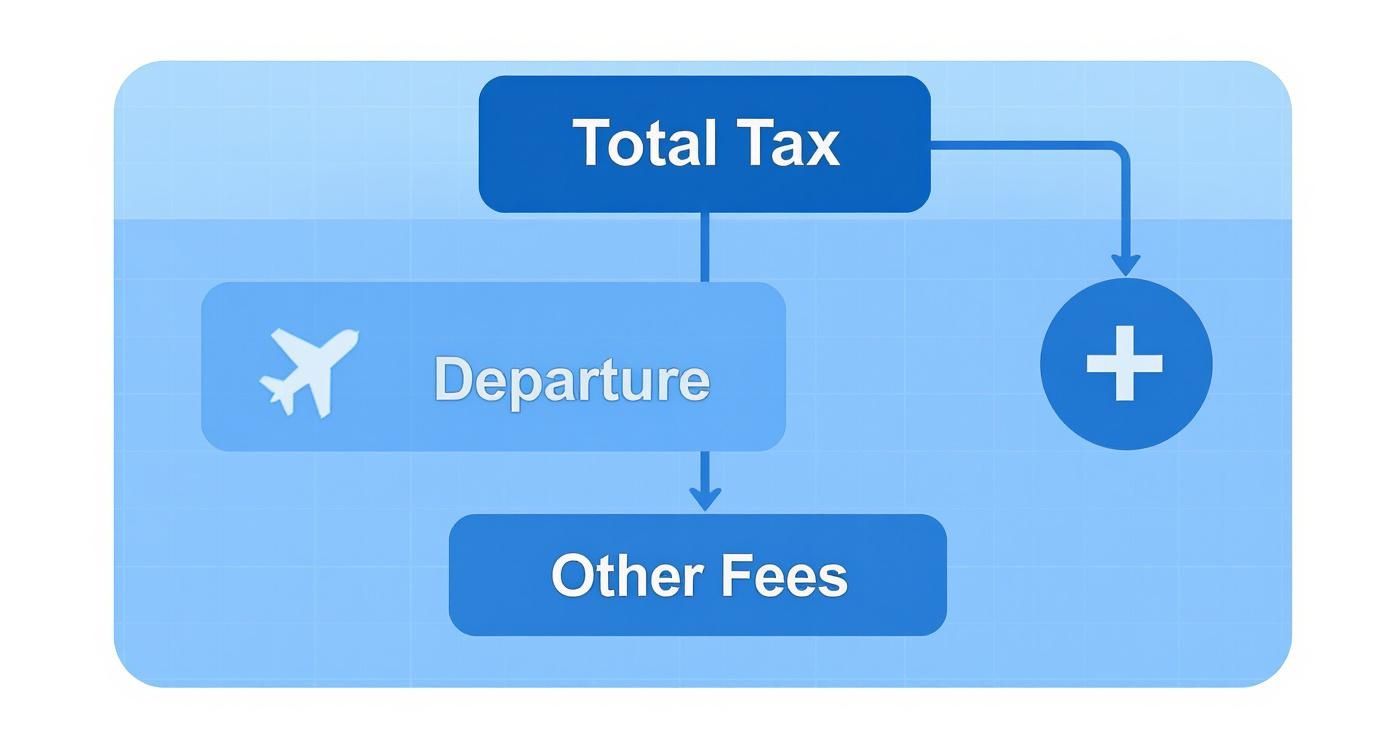
As you can see, the departure fee is the largest portion, but the other fees are essential for airport development. While this tax is specific to the Dominican Republic, frequent international travelers benefit from understanding the costs associated with other international travel authorizations, such as the UK ETA.
At Atlantique Sud, we connect these details to your broader investment strategy. A country that invests in its infrastructure is one poised for sustainable growth, directly benefiting your real estate assets here in beautiful Las Terrenas.
How the Airport Tax Is Collected
For nearly every international traveler, the airport tax is paid seamlessly when you book your flight. Airlines are required to bundle all necessary fees, including the departure tax, directly into your ticket price.
This streamlined approach eliminates the need to handle cash or wait in line at the airport. It's all managed upfront.
We know that navigating the logistics of an international property purchase can be complex. At Atlantique Sud, we believe that clarifying these small details helps you focus on what truly matters: the excitement of finding your dream home in Las Terrenas.
Confirming Your Payment
Curious to see the proof? Simply review your e-ticket receipt. Airlines typically provide an itemized cost breakdown where you can clearly identify the taxes and fees.
We often get asked about the old US$10 tourist card. That fee was also rolled into the airline ticket price a while back. The whole process is now part of the modern E-ticket system. You can get the full story on how this replaced the Dominican Republic Tourist Pass in our detailed guide.
This integrated pricing model works for the vast majority of travellers. Understanding it ensures your arrival and departure are as smooth as the sands of Playa Cosón.
Tax Breaks for Residents and Other Special Cases
One of the key benefits of becoming an official resident in the Dominican Republic is the exemption from the standard US$20 departure tax. While it may seem small, for our international clients who frequently travel, these savings accumulate significantly over time.
This is a straightforward benefit for those who make the Dominican Republic their home. With over 25 years of experience in Las Terrenas, we at Atlantique Sud ensure our clients are aware of every advantage available to them, from travel perks to major tax incentives.

Who Gets a Pass and How to Claim It
The exemption is clear-cut and applies to several specific groups:
- Foreign Nationals with Official Residency: If you hold a valid Dominican residency card, you are exempt.
- Diplomats and Consular Staff: Accredited officials are also exempt.
- Young Children: The tax is typically not applied to tickets for infants under two years of age.
Claiming your exemption is simple. When checking in for your flight, present your valid residency card to the airline agent. They will either process a refund for the tax included in your ticket or adjust the cost on the spot.
This table provides a quick overview.
Departure Tax Status by Traveler Type
| Traveler Category | Departure Tax Status | Documentation Needed |
|---|---|---|
| Tourists | Pay the tax | N/A (Included in ticket price) |
| DR Residents | Exempt | Valid Dominican Residency Card |
| Diplomats/Consular Staff | Exempt | Official Diplomatic Credentials |
| Children (Under 2) | Exempt | N/A (Age verification via passport) |
Securing residency is your ticket to skipping this fee on every departure.
This tax waiver is just the beginning. For property investors, investing in tax-free real estate with CONFOTUR Law offers far greater savings, including a 15-year exemption from the 1% annual property tax and the 3% property transfer tax.
Our legal partners at Atlantique Sud are experts in the residency process. We guide you through every step, helping you unlock valuable perks like the departure tax waiver and setting you on the path to a rewarding investment in Las Terrenas.
How Airport Taxes Impact National Competitiveness
The airport tax, while a small part of your investment, has a major impact on the Dominican Republic's economy. At Atlantique Sud, we have monitored these economic factors for over two decades to provide our clients with a complete market perspective.
For investors and vacation home buyers, the total cost of travel influences the island's appeal. When combined with the country's 18% ITBIS (VAT) on airfare, these fees can create a financial hurdle, making the DR less competitive than other Caribbean destinations. This could potentially slow the tourism growth that fuels the real estate market in areas like the Samaná Peninsula.
The Balancing Act for Investors
This is where a savvy investor sees the full picture. While higher travel costs could temper tourist numbers, the tax revenue is being reinvested into creating world-class airport infrastructure—a clear sign of the government's commitment to long-term tourism growth.
The Dominican Republic’s high air transport taxes are a known competitive disadvantage. The country currently ranks 16th out of 20 in the Latin American “Air Transport Competitiveness Index,” a position largely attributed to its significant ticket sales taxes and arrival fees, which are among the highest in the region. You can discover more insights about how these fees impact competitiveness in the Dominican Republic on Dominican Today.
Expert analysis is crucial here. You must weigh the immediate cost against the long-term benefits of enhanced infrastructure, which drives property values and rental demand—where yields in Las Terrenas currently range from 5.6% to 7.7%.
At Atlantique Sud, we provide the deep market analysis needed to navigate these economic currents. We ensure your investment is built on a solid foundation of expert knowledge, helping you understand how national policies shape the local Las Terrenas real estate market.
Your Trusted Partner in Las Terrenas
Understanding the airport tax Dominican Republic is just one piece of the puzzle. A successful real estate investment here requires deep local knowledge and a trusted guide. For over 25 years, Atlantique Sud has been that guide for international buyers in Las Terrenas.
We provide a complete picture, backed by hard data on market trends, legal frameworks, and critical tax incentives like CONFOTUR. Our decades of experience are your strategic advantage, ensuring you find the right property at the right price with a clear understanding of all associated costs. Proximity to airports is a major benefit, and you can learn more about the Las Terrenas airport in our guide.
Whether you are seeking a luxury beachfront villa, a high-yield rental property, or a plot of land for a custom build, our team is here to make your vision a reality. We simplify the complex, allowing you to invest with absolute confidence.
Ready to explore real estate opportunities in Las Terrenas? Contact Atlantique Sud today for a personalized market consultation and to view our exclusive property listings.
Have Questions? We Have Answers.
Here are quick answers to the questions we frequently hear from our clients at Atlantique Sud regarding the Dominican Republic's airport tax.
Confirming Your Tax Payment
How do I know if the airport tax was included in my flight ticket?
You can be confident that virtually all international airlines automatically include the Dominican Republic's airport fees in your ticket price.
To verify, check your e-ticket for a "Taxes and Fees" section, where charges are typically itemized. If you need further confirmation, a quick call to your airline's customer service can ensure everything is prepaid for a smooth check-in.
Exemptions and Refunds
What is the process for residents to get the departure tax refunded?
As an official Dominican resident, you are exempt from the US$20 departure tax.
Since the tax is prepaid in your ticket, simply present your valid residency card to the airline agent at check-in. They will initiate the refund process for you. Remember to present your card to claim this valuable benefit.
Airport Tax Uniformity
Are airport taxes the same at all Dominican Republic airports?
Yes, for the most part. Key charges like the US$20 departure tax and national infrastructure fees are standardized across major international airports, including Punta Cana (PUJ), Santo Domingo (SDQ), and Puerto Plata (POP).
Punta Cana International Airport (PUJ) is the nation's busiest, handling over 67% of tourists. While minor operational fees might vary slightly between airports, you can budget for the same core tax structure regardless of your arrival or departure point. You can read more about the PUJ airport and its operations on Routes Online.
Navigating the details of travel and residency is just one way we support our clients. For expert guidance on the Las Terrenas real estate market, from identifying the perfect property to crafting a smart investment strategy, contact Atlantique Sud Real Estate today for a personalized consultation.