Understand What Is Virtual Tour in Real Estate: An Agent’s
A virtual tour in real estate is a digital walkthrough that lets buyers explore a home remotely through 360-degree or 3D views. It has moved well beyond novelty, with the global virtual tour market estimated at USD 11.06 billion in 2024 and projected to reach USD 74.36 billion by 2030, a 34.3% CAGR from 2025 to 2030.
If you're shopping for property in Las Terrenas from Montreal, Miami, Paris, or Madrid, you already know the problem. Photos can show finishes and views, but they rarely tell you how a home feels once you move from the entrance to the kitchen, from the living room to the terrace, or from the bedroom to the pool.
That gap matters even more in an international market. Buyers looking at villas in Cosón, condos in Playa Bonita, or hillside homes near El Limón often need to narrow serious options before they book a flight. A virtual tour helps you do that with far more confidence than a photo gallery alone.
Table of Contents
- Introduction Buying Property from Half a World Away
- Beyond Photos Defining the Virtual Tour Experience
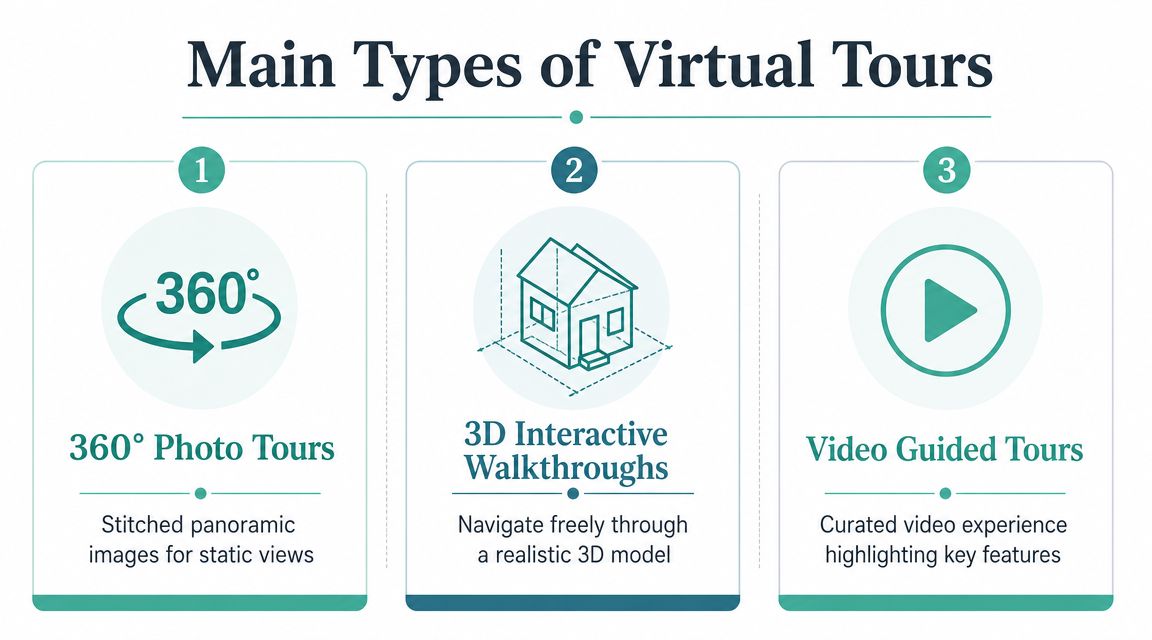
- The Main Types of Virtual Tours You Will See
- Why Virtual Tours Are a Game Changer in Real Estate
- How We Use Virtual Tours for Las Terrenas Properties
- Making the Most of Virtual Tours A Few Practical Tips
Introduction Buying Property from Half a World Away
Buying internationally often starts with too little information and too many tabs open. You compare ocean views, terraces, kitchens, and pools, but what you really need to know is whether the property works for the way you live, visit, or invest.
That is where virtual tours have become part of the modern buying process, not just a marketing extra. Grand View Research estimates the market at USD 11.06 billion in 2024, with a projection to USD 74.36 billion by 2030 and a 34.3% CAGR from 2025 to 2030, which shows how firmly this format has entered mainstream property marketing worldwide (Grand View Research virtual tour market report).
In practical terms, a good virtual tour helps you screen properties before you commit time, travel, and attention. In a market like Las Terrenas, where many buyers begin overseas, that matters. Someone considering a beachfront apartment in Portillo or a family villa above Playa Bonita needs more than beautiful listing photos.
Practical rule: If you're buying from abroad, the first job of a virtual tour isn't to sell you the home. It's to help you eliminate the wrong homes faster.
That makes the rest of the process sharper. You arrive with a shorter list, better questions, and a clearer sense of what deserves an in-person visit.
If you're still at the early stage of researching the cross-border process itself, this overview of how to buy property abroad gives useful context for how remote screening fits into the bigger purchase journey.
Beyond Photos Defining the Virtual Tour Experience
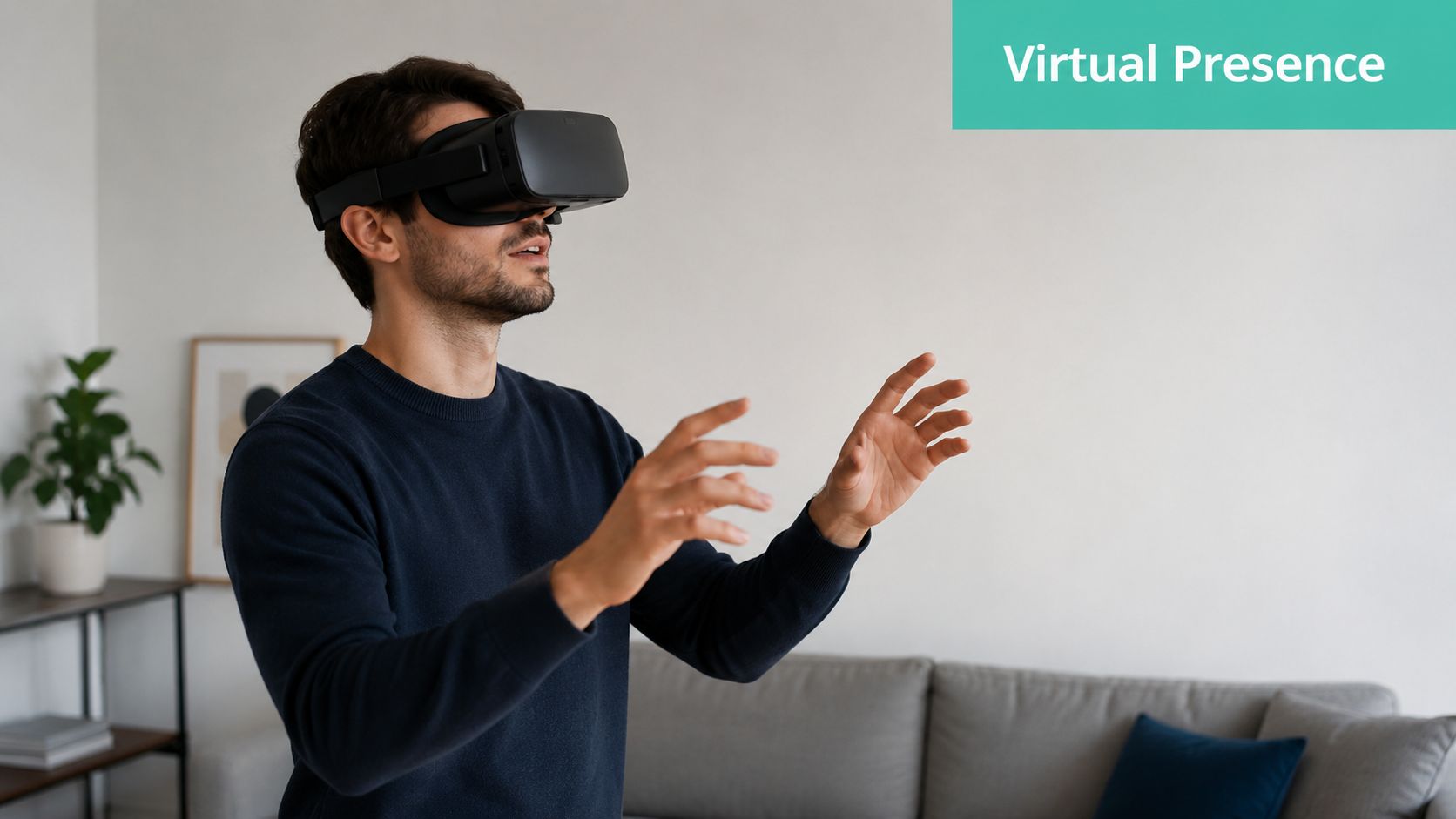
A lot of buyers ask what is virtual tour in real estate, and the simplest answer is this. It is not a slideshow and it is not just a polished video. It is an interactive way to move through a property and look around on your own terms.
Think of it as the interior version of Google Street View. You can look up, down, left, and right. You can move from one space to the next and start building a mental map of the home.
What makes it different from photos or video
Photos are selective by nature. They can highlight finishes, a pool deck, or a sea view, but they don't always show awkward transitions, narrow circulation, or how separated a guest bedroom really is from the main living area.
Video improves on that because it gives motion and sequence. Still, video is guided by the person filming. You see what the camera operator chooses to show, in the order they choose to show it.
A virtual tour changes the control. You decide where to look and how long to stay in each room.
Why spatial context matters
The National Association of Realtors points to spatial context as the main value of a virtual tour. It shows how rooms connect and how the layout flows, which helps buyers judge fit before scheduling an in-person visit (NAR on creating a virtual tour for real estate).
That point is especially important in Las Terrenas. A buyer comparing a condo near Pueblo de los Pescadores with a larger villa in El Limón is not only comparing finishes. They are comparing circulation, privacy, indoor-outdoor living, and whether the layout suits guests, children, or rental use.
A strong virtual tour doesn't replace the physical visit. It makes the physical visit far more productive.
Good tours also expose weaknesses. If the second bedroom opens too close to the kitchen, if the terrace feels disconnected from the pool, or if the home relies on a layout that photos made look cleaner than it is, you can usually spot that early. That honesty is one reason serious buyers tend to value them.
The Main Types of Virtual Tours You Will See
Not every listing that says "virtual tour" means the same thing. Some are basic. Some are excellent. Knowing the difference helps you judge how much confidence to place in what you're seeing.
360° Photo Tours
These are stitched panoramic images placed in sequence. You click from point to point and rotate your view inside each scene.
They are useful, especially for giving a first sense of room size and orientation. They are also lighter and simpler than full 3D capture, which is why you still see them often.
The limitation is that they can feel a bit static. Movement between rooms is less natural, and depth can be harder to judge in complex homes.
Guided Video Walkthroughs
These are agent-led or camera-led tours that move through the property like a short film. They work well when the goal is to highlight mood, sunlight, landscaping, or a dramatic approach to the house.
For a villa in Cosón, a video can do a better job than a static tour at showing the arrival sequence, the sound of the surf in the background, or how the terrace opens at sunset. But video remains linear. You cannot pause at the guest suite and independently inspect what matters to you.
3D Interactive Tours
This is usually the most useful format for serious buyers. Systems in this category allow you to move through a realistic digital model of the home, often with a "dollhouse" view that shows the full layout from above or at an angle.
That bird's-eye perspective is valuable because it reveals relationships that photos tend to hide. You see whether the kitchen is open to the living room, whether bedrooms are grouped together or split across levels, and whether the outdoor space is integrated or detached.
Advanced versions can also include hotspots, embedded video, detail pop-ups, floor plans, and automated measurement tools for wall lengths, ceiling heights, and room dimensions, making the tour useful not just for marketing but as a practical pre-inspection tool (3DVista real estate virtual tour features).
If you want a broader industry comparison of formats, this virtual property tours guide gives a helpful outside look at how different walkthrough tools are used in practice.
Buyers usually get the clearest read from 3D interactive tours because they can test the layout themselves instead of relying on someone else's editing choices.
Interactive Floor Plans
These are simpler, but still useful. You may see a floor plan that lets you click into rooms, view photos, or jump to a related panorama.
They won't give the same immersive feel as a full walkthrough, but they are excellent for orientation. In homes with guest casitas, split-level living, or long indoor-outdoor transitions, a clickable floor plan can clarify the property faster than a gallery ever could.
A quick comparison helps:
| Format | Best for | Limitation |
|---|---|---|
| 360° Photo Tour | Fast visual overview | Less natural sense of movement |
| Guided Video Walkthrough | Storytelling and atmosphere | Viewer can't explore freely |
| 3D Interactive Tour | Layout, navigation, detailed review | Requires stronger capture quality |
| Interactive Floor Plan | Understanding room relationships | Less immersive than full tour |
Why Virtual Tours Are a Game Changer in Real Estate
Virtual tours help everyone in the transaction, but not in exactly the same way. Their strongest value is not magic pricing power. It is better attention, better filtering, and better use of time.
For buyers
A buyer in another country can review properties in Las Terrenas without depending entirely on photo angles or short listing descriptions. That makes it easier to reject homes that don't fit and focus travel on the few that might.
Virtual tours save friction. You don't waste your shortlist on homes that looked spacious in photos but feel disjointed once you understand the layout.
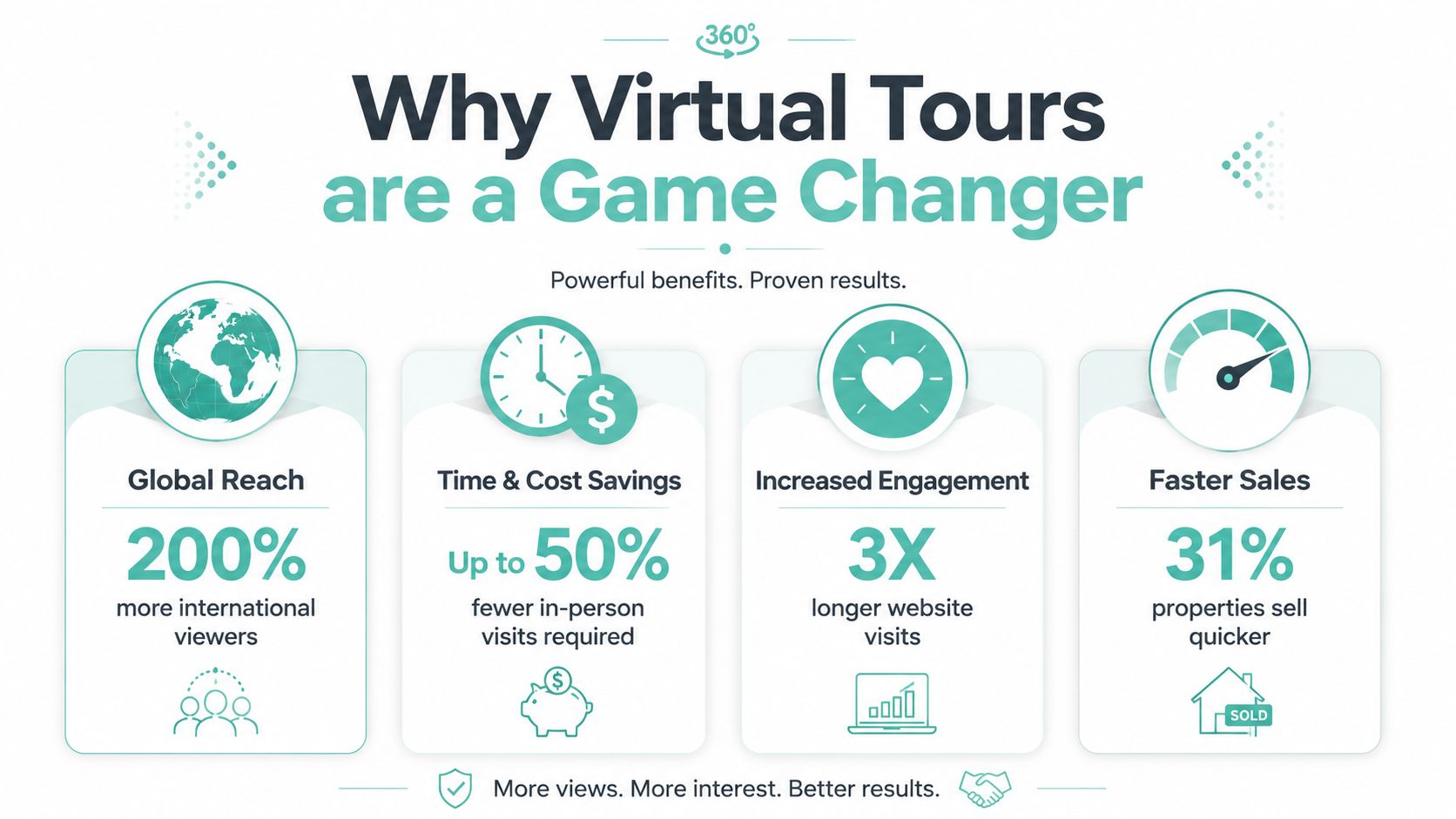
Here is a useful industry snapshot. Listings with virtual tours get 40% more clicks and 95% more phone inquiries, according to the figures compiled by PhotoUp and Matterport in this roundup of real estate virtual tour statistics. More attention doesn't mean every click is valuable, but it does mean buyers are engaging more fully with listings that offer a better preview.
A short video example helps show how this works in practice.
For sellers
For sellers, the biggest advantage is reach with better qualification. A virtual tour lets a buyer abroad inspect the home seriously before asking for a showing or making travel plans.
That matters in Las Terrenas because the audience is often international. A seller with a villa in Playa Bonita or a condo in Portillo doesn't just need visibility. They need interested buyers to understand the property properly before conversations get serious.
PhotoUp also reports that properties with tours sell for 9% more on average and close 31% faster than those without in the data summarized on that same virtual tour statistics page, but there is an important caveat in the same body of reporting. Harvard Business School research based on 75,000 home sales found that once photo quality and descriptions were controlled for, virtual tours had an insignificant effect on final prices. In plain terms, a primary advantage may be stronger engagement and better buyer filtering, not an automatic price premium.
Sellers should treat a virtual tour as a quality filter. It attracts people who want a closer look and discourages casual browsers who were never likely to move forward.
For agents
For agents, good tours reduce wasted appointments and improve conversations. Instead of spending a first showing explaining basic layout, the discussion can focus on the buyer's actual concerns such as privacy, view lines, access, renovation potential, or rental suitability.
That improves transparency too. A buyer who has already walked the home virtually tends to ask sharper questions, and that usually leads to a cleaner in-person visit.
How We Use Virtual Tours for Las Terrenas Properties
In Las Terrenas, the value of a virtual tour becomes obvious the moment the buyer is not physically here. That is common with second-home buyers, retirees planning a move, and investors comparing several Caribbean markets at once.
Remote buying in coastal neighborhoods
A beachfront condo in Playa Bonita raises one set of questions. Buyers want to understand terrace depth, sightlines to the water, and how the living area connects to outdoor space. A virtual tour answers those points much better than still photos.
A hillside property near El Limón raises different ones. There the buyer usually wants to understand elevation changes, privacy between rooms, how guest suites sit relative to the main house, and whether the house flows naturally for full-time living or is better suited to vacation use.
The same goes for walkable areas near Pueblo de los Pescadores, where buyers often care about access, compact layouts, and how indoor space balances with balconies or roof terraces. A proper tour gives the buyer context, not just decoration.
Live guided walkthroughs for serious buyers
Recorded tours are useful, but live remote walkthroughs often add another layer. In a guided session, the agent and buyer move through the property together on screen. The buyer asks to pause, turn, zoom, revisit a room, or focus on a detail.
That changes the quality of the conversation. Instead of a generic sales presentation, the session becomes practical. The buyer can ask about kitchen storage, bedroom separation, staircase width, or whether a covered terrace feels protected enough for year-round use.
For buyers who want to see how this works with local inventory, our Las Terrenas real estate tours page shows how remote viewing fits into a serious property search.
In international markets, the best virtual tours are not passive content. They become part of the decision-making conversation.
Making the Most of Virtual Tours A Few Practical Tips
Virtual tours work best when buyers and sellers use them properly. A rushed viewing tells you very little. A well-prepared one can save weeks of confusion.
For buyers
Use the tour like a screening tool, not entertainment.
- Start with the full layout: If the platform offers a dollhouse or floor-plan view, begin there. It gives you the structure of the home before you get distracted by finishes.
- View it on a larger screen: A phone is fine for a quick look, but a laptop or desktop makes room relationships much easier to judge.
- Go through the property twice: The first pass is for orientation. The second is for questions about storage, privacy, circulation, and outdoor access.
- Check transitions, not just rooms: Many buying mistakes happen in the spaces between rooms. Focus on hallways, stairs, door placement, and how the terrace connects to the main living area.
- Ask follow-up questions: If something looks tight, unclear, or oddly proportioned, ask for clarification rather than guessing.
- Pair the tour with due diligence: A virtual tour helps with fit. It does not replace title review, document checks, or transactional verification. This real estate due diligence checklist is the right next layer once a property stays on your shortlist.
For sellers
Preparation matters more than many owners expect. A 3D scan captures everything. That is the strength of the format, but it also means clutter, poor lighting, and unfinished details are much harder to hide.
- Declutter before capture: Clear counters, simplify shelves, and remove personal overflow from bedrooms and bathrooms.
- Finish small fixes: A missing handle, crooked curtain, or visible cable can stand out more in an interactive tour than in still photography.
- Open the house properly: Turn on lights, open interior doors where appropriate, and make terraces, patios, and pool areas feel accessible.
- Stage for flow: The goal is not only beauty. It is readability. Furniture should help buyers understand movement through the space.
- Think like a remote buyer: Someone overseas cannot fill in the blanks. The home needs to present clearly and accurately from the first click.
A good virtual tour doesn't replace photos, in-person showings, or professional advice. It makes all three more efficient. In a market like Las Terrenas, where many decisions begin abroad, that is exactly why virtual tours have become standard for serious property marketing.
If you're exploring homes from overseas and want clear, practical guidance on what deserves an in-person visit, Atlantique Sud Real Estate can help you review the right opportunities in Las Terrenas with more confidence.