


Santo Domingo Realty: Expert Investor Insights 2026
If you're looking at the Dominican Republic with capital to deploy, the first fork in the road usually isn't whether to buy. It's where.
For many international buyers, the choice comes down to two very different bets. Santo Domingo realty offers liquidity, business-driven rental demand, and a market deep enough to support multiple strategies. Las Terrenas offers a coastal lifestyle, lower entry points in many cases, and a tourism-led return profile that can outperform when the asset and management are right.
Both work. Both also punish lazy underwriting.
The Santo Domingo Real Estate Market An Overview
A foreign investor lands in Santo Domingo on Monday, tours three towers on Tuesday, and thinks he has seen the market by Wednesday. He has not. The capital is broad, fragmented, and far less uniform than it looks from a shortlist of glossy listings.
That is the first adjustment I make with clients who know us from Las Terrenas. In a coastal market, you can often underwrite around tourism, walkability to the beach, and property management quality. In Santo Domingo, the variables shift. Here, the outcome depends much more on micro-location, commute patterns, building operations, and the depth of local end-user demand.
The market moves by submarket, not by headline
Santo Domingo is one metro area on paper and several distinct property markets in practice. Distrito Nacional behaves differently from Santo Domingo Este. Santo Domingo Norte follows a different appreciation path again. Product type matters too. A well-run mid-market apartment in the right corridor can outperform a more expensive unit with weak tenant appeal.
Recent pricing data from the Oficina Nacional de Estadística, as summarized earlier by Sunlife Realty, showed much faster price growth in Santo Domingo Norte and Santo Domingo Este than in the traditional core, where Distrito Nacional posted a far more modest increase. That spread matters. It means prestige alone is not a strategy, and investors who buy by district reputation can miss the strongest growth pockets.
For a clearer sense of how these municipalities connect, this overview of the Santo Domingo metro area and its urban footprint is useful.
Demand is tied to daily life
What gives Santo Domingo real estate its depth is not hype. It is use.
The city pulls demand from professionals who want to live near office nodes, families who prioritize schools and services, students, medical-sector tenants, and owner-occupiers trading up within the capital. That demand base is less romantic than a beach market, but it is often more stable. Stable does not mean automatic. It means investors need to match the unit to a real renter or resale buyer, not to a marketing brochure.
I usually give clients one simple rule. In Santo Domingo, a standard apartment in the correct micro-market often beats a prettier apartment in the wrong one.
Pricing supports interest, but underwriting still matters
The broader Dominican pricing context also helps explain why the capital stays on international buyers' radar. Verified market summaries cited by Sunlife Realty place the country's average asking levels well below comparison markets such as Miami and San Juan. Santo Domingo fits that relative value story, especially for buyers who want a capital-city asset rather than a resort-oriented hold.
Still, this is not a forgiving market. New supply can pressure rents in fashionable zones. Older buildings can look cheap at acquisition and expensive in practice once maintenance, backup power, elevators, and reserve issues show up. Some projects are built for resale optics rather than long-term livability, which usually hurts both tenant retention and exit value.
The trade-off
Compared with Las Terrenas, Santo Domingo offers more liquidity, a deeper tenant pool, and more resale routes. It also demands more precision. You are buying into a working city where transport friction, neighborhood identity, and building management have a direct effect on yield.
The investors who perform best here stay disciplined on three points:
- They buy for proven demand. Executive rentals, family corridors, and mixed end-user areas are safer than buying on branding alone.
- They respect the building, not just the unit. HOA standards, generator reliability, water systems, parking, and elevator uptime affect rentability.
- They keep assumptions conservative. The capital rewards solid underwriting, not optimistic projections.
Santo Domingo deserves serious attention from international investors. It just needs to be treated like an operating market, not a story stock.
Where to Invest A Neighborhood Breakdown
Within Santo Domingo, location choice isn't a cosmetic decision. It's the whole strategy.
Two apartments with similar finishes can behave very differently depending on whether you're targeting executive tenants, heritage tourism, commuter-family demand, or edge-of-growth appreciation.
Piantini Naco and Serrallés
If you want Santo Domingo's most recognizable urban product, many buyers start here.
These districts appeal to professionals, executives, and tenants who value newer towers, security, parking, backup systems, and proximity to offices, restaurants, and retail. The investment thesis here is usually stable demand rather than bargain entry pricing.
What works in these neighborhoods:
- Clean, functional apartments: Good layouts often outperform flashy but awkward interiors.
- Reliable building operations: Elevators, power backup, parking, and maintenance standards matter a lot.
- Conservative rent assumptions: Premium neighborhoods attract better tenants, but they also attract more competing inventory.
What doesn't work as well is overpaying for trend-driven luxury with no clear rental audience. In these zones, buyers often assume prestige alone will carry returns. It won't.
Prime neighborhoods in the capital are usually the easiest place to be "mostly right" and still protect your downside.
Bella Vista and Evaristo Morales
These areas often appeal to investors who want a middle ground.
They're still established and well-serviced, but they can offer a slightly different value equation than the most headline-grabbing business districts. The tenant profile is often a mix of professionals and families who care about convenience more than status signaling.
That tends to create durable demand for long-term lets.
A practical advantage in these neighborhoods is that the buyer pool on resale is often broad. You're not relying on one narrow luxury niche. You're serving both local and international demand if the building is well-run.
Colonial Zone
The Colonial Zone is a different animal entirely.
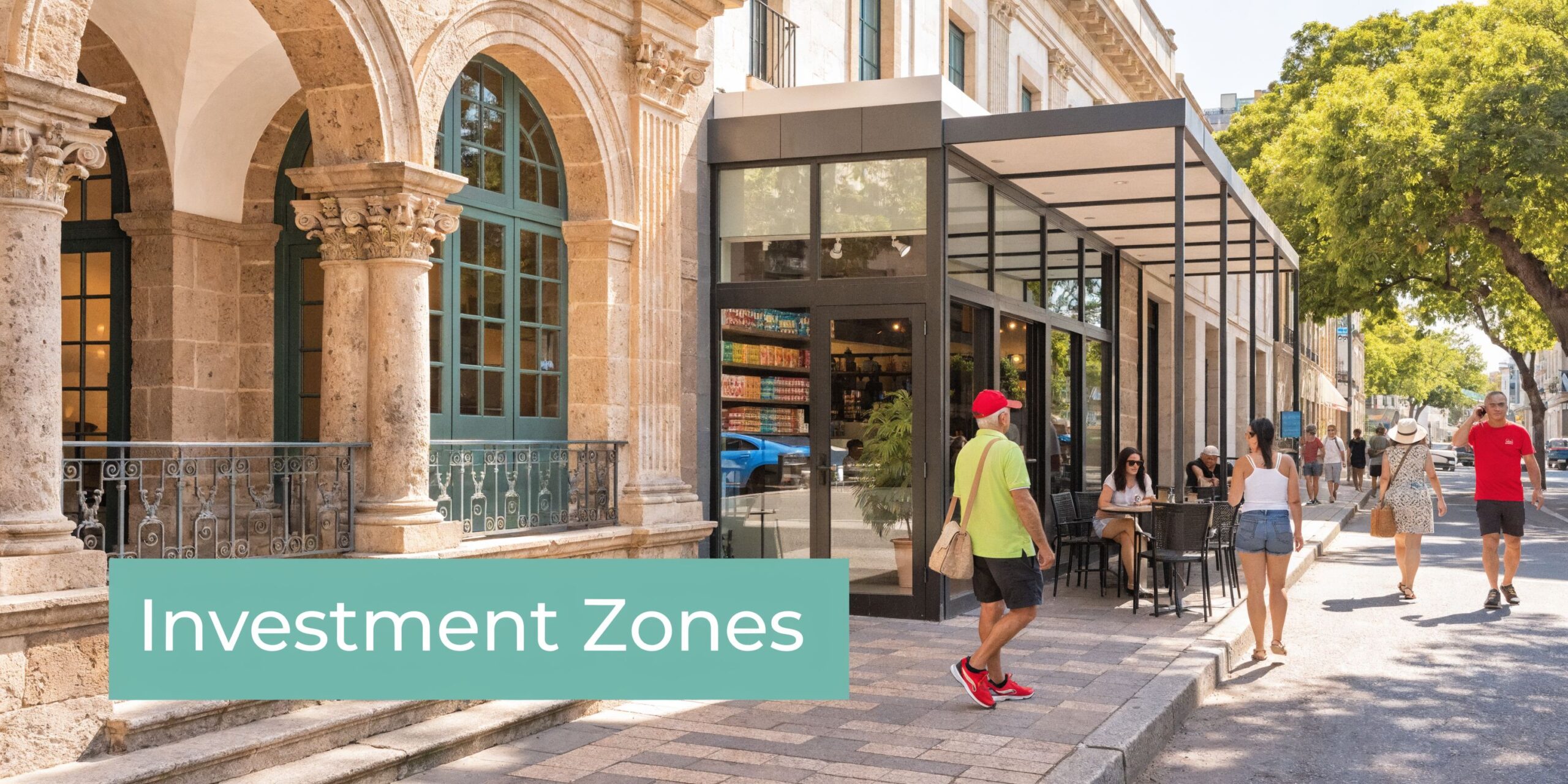
You don't buy here for the same reasons you buy in Piantini. You buy for walkability, architectural character, tourism adjacency, and a product that can appeal to short-stay demand or to buyers who value heritage over tower living.
The opportunity is obvious. So is the risk.
Historic charm can command attention, but operational issues matter more in older stock. Title clarity, renovation quality, building systems, and realistic management plans matter a lot. This is the type of area where a beautiful listing can hide an awkward investment.
A street-level look helps explain why this district remains so attractive:
Santo Domingo Este
For investors focused on growth rather than established prestige, Santo Domingo Este deserves attention.
The strongest case here is urban expansion. You are often underwriting the next wave of practical demand, not just today's address premium. The area has seen meaningful appreciation and continues to attract attention because of residential growth and commercial spillover.
This isn't a one-size-fits-all zone, though. Some pockets will age well and densify properly. Others may produce supply that competes too directly with itself.
When evaluating Santo Domingo Este, look closely at:
- Access patterns: Roads, daily commute logic, and proximity to commercial nodes.
- Local services: Schools, shopping, and healthcare support tenant stickiness.
- Future competing stock: Too much similar product nearby can pressure rents and resale.
Santo Domingo Norte
Santo Domingo Norte is where many investors get interested for the wrong reasons and where some of the smartest buyers find opportunity for the right reasons.
The wrong reason is chasing appreciation headlines without understanding the micro-market. The right reason is identifying corridors where urban growth is creating genuine future demand, then buying product with broad usability.
Because this area has been moving faster in price than the traditional core, discipline matters even more. Investors shouldn't assume every project in a hot municipality is equally investable.
A simple way to match area to strategy
A useful frame is this:
| Goal | Better fit in Santo Domingo |
|---|---|
| Stable long-term rental demand | Piantini, Naco, Bella Vista, Evaristo Morales |
| Character-driven short-stay or niche demand | Colonial Zone |
| Growth-oriented appreciation play | Santo Domingo Este and selected parts of Santo Domingo Norte |
| Lowest execution risk | Established, well-serviced central neighborhoods |
The capital rewards specificity. If your brief is "buy something in Santo Domingo," that's too vague. If your brief is "buy a professionally managed apartment that appeals to executive long-term tenants in a proven corridor," you're thinking like an investor.
Investment Analysis Typical Costs and Potential Returns
The easiest mistake in Santo Domingo is to treat gross yield as the answer. It isn't. It's the starting point.
A workable deal in the capital usually comes from the interaction of entry price, negotiation room, rent durability, building costs, and your exit horizon.
What the income side looks like
For apartments, Santo Domingo delivered gross rental yields of 7.9% as of Q1 2025, with a range of 7.46% to 8.36%, and early 2026 data confirmed a citywide gross yield of 8.5%, according to Global Property Guide's Dominican Republic price history.
That's strong enough to get serious investors interested.
But gross yield only means something if the unit rents to the right tenant profile at a sustainable level. In practice, the best performers aren't always the most luxurious units. They're often the easiest units to re-rent.
How experienced buyers usually underwrite it
A sensible capital-city underwriting model usually assumes:
- Rent first, story second: Start with realistic tenant demand in the building and block, not best-case asking rents.
- Maintenance discipline: Premium towers can look attractive on paper and disappoint after fees.
- Resale patience: You should expect to hold long enough to absorb friction and market cycles.
A property that looks slightly boring on day one often makes a better landlord asset than a highly styled unit with a narrow tenant audience.
If you want to benchmark the city against other markets, this overview of global property investing and rental yield by country is a useful context tool. It won't replace local underwriting, but it helps frame where Santo Domingo sits in the broader yield conversation.
Typical buyer closing cost framework
For foreign buyers, one of the most practical budgeting questions is how much to reserve beyond the purchase price.
The verified research provided for this article states that the 3% property transfer tax is the largest mandatory line item in Santo Domingo, while legal and notary fees commonly fall into a separate professional-services bucket. Based on that verified fee structure, a buyer should model closing costs item by item rather than relying on a vague all-in estimate.
| Estimated Closing Costs for Buyers in Santo Domingo | Percentage of Purchase Price |
|---|---|
| Property transfer tax | 3% |
| Legal and notary fees | 1.5% to 2.5% |
| Mortgage registration tax if financing | 2% |
That table is the practical core. The exact final number depends on how you're buying, whether the title file is clean, and whether financing is involved.
For investors also planning an eventual exit, it's smart to understand the selling side early. This overview of what are capital gains taxes is helpful because round-trip cost planning is where many overseas buyers get too optimistic.
What works and what doesn't
There are two Santo Domingo buy-to-let models that usually make sense.
The first is the straightforward long-term apartment strategy in a proven district with broad tenant appeal. The second is a carefully selected unit in a more specialized area where the niche demand is already visible.
The weaker approach is buying purely off brochure logic. If the asset depends on perfect occupancy, aggressive rent growth, or a future buyer paying far more for the same story, the margin of safety is thin.
A better filter is this short checklist:
- Can a local professional or family afford and want this unit?
- Would the same building still look competitive if several neighboring units came up for rent at once?
- Would you still be comfortable owning it if financing stays expensive longer than expected?
If the answer to any of those is shaky, the spreadsheet probably looks better than the deal does.
Navigating the Purchase Process A Foreign Buyer Checklist
Foreigners can buy property in the Dominican Republic without a special ownership barrier. The issue usually isn't permission. It's execution.
In Santo Domingo, the safest buyers aren't the fastest buyers. They're the ones who control the process from offer through title transfer with disciplined due diligence.
Start with negotiation before paperwork
In the current Santo Domingo market, high mortgage rates above 11% have pushed many deals to a 94% to 97% sale-to-asking ratio, which means skilled buyers can often secure 3% to 6% discounts off list price, according to The LatInvestor's Santo Domingo market analysis.
That should shape how you enter negotiations.
List price is a position, not a conclusion. In practice, buyers who come in with clean terms, documented proof of funds, and a clear closing path usually get more traction than buyers who focus only on the headline discount.
A workable buyer sequence
The purchase flow is simple on paper. The details are where problems happen.
Select the asset carefully
Don't fall in love with photos. Review title status, building condition, common-area quality, and the neighborhood's rental audience.Make a formal offer with terms
Price matters, but so do payment timing, contingencies, included furnishings, and how deposits are handled.Hire an independent attorney
This is not optional. The attorney's job is to verify title, ownership, encumbrances, and the transaction structure.Run full due diligence
For condos, don't stop at the title. Check building administration, maintenance standing, and whether there are unresolved issues that affect use or resale.Execute the purchase agreement
The agreement should reflect the exact parties, property description, payment mechanics, and conditions.Close and register correctly
A signed deal isn't the end. Registration and title transfer are what secure ownership.
For a broader overview of the legal flow, this guide on how to buy a property in the Dominican Republic is a helpful companion.
What foreign buyers often underestimate
The most common mistake isn't legal ignorance. It's assuming that a nice building equals a simple purchase.
Santo Domingo has plenty of attractive inventory. Not all of it is equal in paperwork quality, maintenance standards, or resale logic. A unit can look turnkey and still produce headaches because the building administration is weak or because the file wasn't reviewed properly before money moved.
Dealbreaker test: If the seller, broker, or administrator creates friction around basic document review, slow the process down immediately.
A practical checklist before you wire funds
Use this as a minimum standard:
- Title verification: Confirm the seller can legally transfer the property.
- Lien review: Make sure there are no unresolved claims or encumbrances.
- Condo review: Check fees, arrears, rules, and building management quality.
- Payment controls: Keep all funds documented and routed properly.
- Translation and comprehension: If Spanish isn't your working language, make sure every material document is fully understood before signature.
The timeline mindset that helps most
The best foreign buyers treat the transaction as an acquisition process, not an emotional event.
That mindset changes everything. You negotiate better. You ask better questions. You don't get rushed by "another buyer is coming" pressure unless the facts support it.
In Santo Domingo, where there is opportunity but also variation in asset quality, process discipline is part of the return.
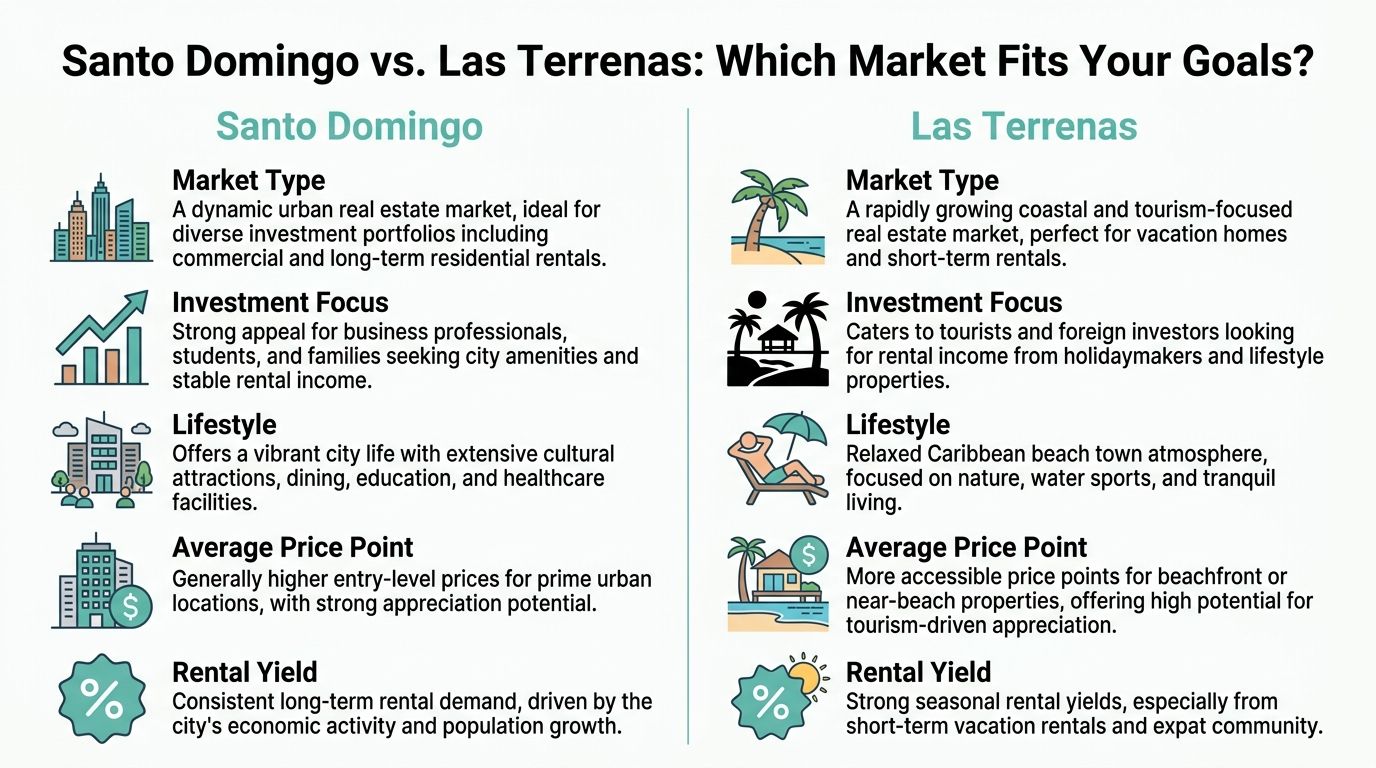
Santo Domingo vs Las Terrenas Which Market Fits Your Goals
Most international investors don't need a lecture on whether city property is different from beach property. They know that already.
What they usually need is a clean comparison of which market fits their objective, because Santo Domingo realty and Las Terrenas solve different problems.
If your priority is lower entry cost
Las Terrenas has the edge.
A key difference in the verified market data is that Las Terrenas offers 15% to 30% lower entry prices for comparable properties, including beachfront condos from $200,000, and often delivers higher rental yields of 5.6% to 7.7% average compared with urban gated communities in Santo Domingo, according to DR Listings' comparison of gated community options.
That doesn't mean every Las Terrenas deal is cheaper in absolute terms. Premium beachfront product can still be expensive. But on a like-for-like lifestyle basis, you often get more distinctive real estate for the money on the north coast.
If your priority is broad tenant demand
Santo Domingo usually wins.
The capital has a deeper pool of long-term users. Professionals, families, students, and business-linked tenants create a demand base that doesn't depend on holiday seasonality in the same way a beach market does.
That gives many investors more comfort. You are often underwriting urban necessity rather than discretionary travel demand.
If your priority is lifestyle value
Las Terrenas is hard to beat.
Our home market has a structural advantage here. A buyer comparing tower living in the capital with daily life near Playa Bonita, Cosón, Portillo, or Pueblo de los Pescadores isn't just comparing asset class. They're comparing the kind of life the property delivers.
For second-home buyers, semi-retirees, and investors who also plan to use the asset, that matters a lot. Santo Domingo offers culture, services, dining, and convenience. Las Terrenas offers a slower rhythm, beach access, and a much more leisure-centered ownership experience.
Some investors buy the city for returns and the coast for themselves. Others want one property to do both jobs. That's where the distinction becomes important.
If your priority is operational simplicity
Neither market is "easy." They are easy in different ways.
Santo Domingo is usually easier to understand from a traditional landlord perspective. You are leasing into a city with established residential use patterns. The management questions are familiar.
Las Terrenas can produce a more tourism-driven income profile, but that often requires stronger on-the-ground management, guest operations, and clearer seasonal strategy. If you don't plan for that, your projected upside stays theoretical.
If your priority is appreciation logic
The logic is different in each market.
In Santo Domingo, appreciation often comes from urban expansion, densification, and the steady pull of the country's economic center. In Las Terrenas, appreciation tends to be tied to coastal scarcity, tourism appeal, international demand, and the continued strengthening of the town as a lifestyle destination.
One is a capital-city story. The other is a curated coastal story.
A practical side-by-side investor scorecard
| Investor priority | Santo Domingo | Las Terrenas |
|---|---|---|
| Long-term rental depth | Stronger | More selective |
| Lifestyle use by owner | Limited unless you want city living | Much stronger for second-home use |
| Entry pricing for distinctive product | Often higher in prime zones | Often more accessible |
| Tourism upside | Secondary | Core part of the thesis |
| Need for active rental management | Moderate | Higher if short-term focused |
| Portfolio role | Urban income and liquidity | Lifestyle plus tourism-led returns |
What works for different investor types
The income-focused landlord often fits Santo Domingo better, especially if they want long-term leases and a businesslike hold.
The hybrid buyer who wants personal use plus rental upside often fits Las Terrenas better. A well-chosen condo or villa near the coast can do a job that a city apartment cannot.
The portfolio investor may want both. One urban asset for stability. One coastal asset for upside and lifestyle diversification.
The honest answer
There isn't a universal winner.
If you want a market with broad urban demand, more conventional rental logic, and a larger local buyer base, Santo Domingo makes a strong case. If you want a beach market with lower comparative entry points, a more enjoyable ownership experience for many foreign buyers, and a compelling tourism angle, Las Terrenas often comes out ahead.
The best choice depends on the role the property needs to play in your life and balance sheet.
Frequently Asked Questions About Santo Domingo Realty
Is Santo Domingo better for long-term rental income or short-term rentals
For most foreign investors, Santo Domingo makes more sense as a long-term rental market.
Short-term rentals can work in selected buildings and submarkets, but the margin for error is tighter. Analysts at AirROI's Santo Domingo market report found average annual STR revenue of $7,879 per property, 37% occupancy, and a $79 ADR, while apartment yields in the city sit in the 7.46% to 8.36% range. In practice, that means a standard apartment in the capital should not be underwritten like a tourism-driven coastal rental.
I tell clients to treat Santo Domingo as an income market first, and an STR market only if the unit, building rules, and location all line up.
Is financing attractive for foreign buyers
Usually no, especially if the plan depends on local peso debt.
High borrowing costs can erase a good deal very quickly. Santo Domingo currently suits cash buyers, or buyers with financing outside the Dominican Republic, better than buyers relying on local mortgages. That also makes purchase price discipline more important. If you overpay, financing will not rescue the return.
Is Santo Domingo a safe place to buy as a foreigner
Foreigners can buy property in the Dominican Republic. The question is whether the purchase is handled correctly.
A disciplined buyer can acquire safely. A casual buyer can create avoidable problems. Independent legal review, title verification, seller due diligence, and controlled deposit terms matter far more than passport nationality.
Are short holding periods a good idea
Usually not.
Santo Domingo works better for buyers with a medium-term view. If the investment case depends on a fast resale at a sharply higher price, the risk goes up. Liquidity exists, but it is not evenly distributed across every building, unit type, or price band.
Which type of property is usually the safest first purchase
For many overseas buyers, a well-located apartment in an established neighborhood is the cleanest starting point.
It is easier to rent, easier to value, and usually easier to resell than highly specialized stock. Buyers often get into trouble by chasing a flashy unit with a narrow tenant pool instead of buying a property that local demand can absorb.
Buy your first Dominican property for clarity, not creativity.
What is the biggest operational mistake foreign investors make after closing
They underestimate building-level controls.
In Santo Domingo, two apartments on the same street can perform very differently because the condominium rules, maintenance quality, reserve funding, and management discipline are different. I have seen foreign buyers focus on finishes and views, then discover later that the building restricts short stays, handles collections poorly, or lets common areas deteriorate. That affects rentability and resale more than many first-time buyers expect.
What is the biggest mistake foreign investors make in Santo Domingo
They buy the wrong product for the wrong tenant.
That usually shows up in one of two ways. Some buyers choose high-end inventory that photographs well but rents to a very narrow audience. Others buy in a growth corridor without checking whether the specific project will still compete in three to five years once newer stock enters the market.
Good investing here starts with tenant fit, not showroom appeal.
Can Santo Domingo fit inside a wider Dominican portfolio
Yes, and for many investors it should.
A balanced Dominican allocation often benefits from having one urban asset and one coastal asset. Santo Domingo can provide steadier residential demand and a broader resale audience. A coastal holding serves a different purpose. It can give the owner personal use, different demand drivers, and exposure to another part of the market cycle.
If you're weighing Santo Domingo realty against the north coast, or trying to decide how each fits your portfolio, Atlantique Sud Real Estate can help you evaluate both with a practical, investor-first lens. Contact Atlantique Sud for a personalized market consultation.
Comparing locations? See our listings in Las Terrenas on the Samaná Peninsula — many buyers find better value and a more authentic lifestyle here.


