What Are Capital Gains Taxes in the Dominican Republic?
Welcome to your essential guide on capital gains tax in the Dominican Republic, put together by us at Atlantique Sud. With over 25 years of hands-on experience in the Las Terrenas real estate market, we know what investors need to know.
Put simply, capital gains tax is a tax on the profit you make when you sell a property for more than you paid for it. This guide is designed to cut through the complex legal jargon and give you clear, straightforward answers based on our decades of helping international buyers successfully invest in the Samaná Peninsula.
Understanding Dominican Republic Capital Gains Tax

When you decide to invest in the vibrant real estate market here in Las Terrenas, getting a handle on your tax obligations is absolutely key to maximizing your returns. One of the first questions we always get from foreign buyers is about capital gains tax. As your trusted local experts since 2000, we're here to make the whole topic feel transparent and totally manageable.
What Is the Capital Gains Tax Rate?
In the Dominican Republic, the capital gains tax rate for both individuals and companies is a flat 27% on the net profit you make from a property sale. This is a critical number for any investor to build into their financial planning. It’s a national tax, overseen by the Dominican tax authority, the Dirección General de Impuestos Internos (DGII).
Now, the important part is that this rate applies to the profit, not the total sale price. Think of it this way: you buy a beautiful two-bedroom condo in the popular Las Ballenas neighbourhood for $250,000. After a few years of enjoying those incredible ocean views and a healthy rental market, you decide to sell it for $400,000. Your profit, or capital gain, is $150,000.
The tax is calculated on this $150,000 gain, not the full $400,000 sale price. This is a critical distinction that often brings a sigh of relief to our first-time international clients.
To give you a clearer picture, here is a quick overview of how the tax works for foreign investors.
Dominican Republic Capital Gains Tax at a Glance
|
Tax Component |
Details for Foreign Investors |
|---|---|
|
Tax Rate |
A flat 27% on the net profit from the sale. |
|
Taxable Amount |
The difference between the sale price and the original purchase price (plus eligible costs). |
|
Who Pays? |
The seller is always responsible for paying the tax. |
|
When Is It Paid? |
Before the property title can be transferred to the new owner. |
|
Governing Body |
Dirección General de Impuestos Internos (DGII). |
This table neatly sums up the core elements, but let's dive into who exactly is on the hook for this payment.
Who Is Responsible for Paying This Tax?
The seller of the property is always responsible for paying the capital gains tax. This is a non-negotiable step in the property transfer process. Before the title can officially be passed to the new buyer, the seller has to show proof that the capital gains tax has been settled with the DGII.
This system makes sure the government gets its revenue and, just as importantly, provides the buyer with a clean, unencumbered title. For our clients at Atlantique Sud, we manage this entire process alongside trusted local lawyers and accountants, making sure every detail is handled correctly and without any fuss.
Navigating this is a standard part of what we do. Whether you're selling a luxury villa in Playa Bonita or a rental apartment in El Portillo, our 25+ years of experience ensure a smooth and successful closing. Ready to explore your investment potential in Las Terrenas? Contact our expert agents today for personalized guidance on buying or selling property in paradise.
How to Calculate Capital Gains Tax
Alright, let's get into the numbers. Calculating the capital gains tax on your Las Terrenas property might seem daunting, but it’s more straightforward than you think. With over 25 years of experience guiding clients at Atlantique Sud, we've boiled this down to a simple process. Getting this right is absolutely essential for predicting your actual return on investment, so let’s walk through it together.
The whole calculation really comes down to one thing: your net gain. To figure that out, you first have to nail down your property's cost basis.
Establishing Your Cost Basis
Think of your cost basis as the total amount of money you've truly sunk into the property. It's not just the price on the sales agreement. The formula is simple:
Original Purchase Price + Documented Capital Improvements = Cost Basis
"Capital improvements" aren't just any old repairs. We're talking about significant, permanent upgrades that genuinely increase your property's value. Think about adding a beautiful new swimming pool to your villa in the hills of Cosón, completely remodelling a kitchen in a beachfront condo in Playa Bonita, or building a new guest bungalow on your land. Routine maintenance doesn't count.
This is why we tell all our clients to be absolutely meticulous about record-keeping. Every receipt for these major projects is gold. Every dollar you can prove you spent on improvements raises your cost basis, which directly lowers your taxable gain. From day one, start a dedicated file for these expenses. You’ll thank yourself later.
The Inflation Adjustment Advantage
Now here’s a powerful tool many foreign investors miss. The Dominican Republic tax law offers a major advantage: you can adjust your cost basis for inflation. The Dominican tax authority (DGII) allows your original cost basis to be officially adjusted using the published Consumer Price Index for every year you've owned the property.
This is a game-changer. Over several years, this adjustment can significantly pump up your cost basis on paper, reflecting the time value of money and shrinking your final tax bill. It's not automatic, though. It requires a formal calculation by a local accountant (contador), a service we always coordinate for our selling clients to make sure they get the full benefit.
Calculating the Net Gain and Final Tax
Once you have your inflation-adjusted cost basis, the final math is easy.
-
Find Your Net Gain: Just subtract your adjusted cost basis from the final sale price.
-
Calculate the Tax: Apply the 27% capital gains tax rate to that net gain.
Sale Price – Adjusted Cost Basis = Net Gain
Net Gain x 0.27 = Capital Gains Tax Owed
This process determines the tax you owe here in the DR, but don't forget to consider how your home country's rules might play in. For instance, California's capital gains tax system is a different beast altogether. It taxes all gains as ordinary income, making no distinction between short-term and long-term holdings. Rates there can soar from 9.3% to 13.3% based on income—a huge difference from the DR's flat rate on profit. You can learn more about the complexities of California's specific approach and see why understanding both sets of local rules is critical.
A Practical Las Terrenas Example
Let's make this real. Imagine you bought a beachfront villa in Playa Bonita five years ago for $400,000. While you owned it, you added a new terrace and upgraded the bathrooms for a documented cost of $50,000.
-
Original Cost Basis: $400,000 + $50,000 = $450,000
-
Inflation Adjustment: Let's say the cumulative inflation over those five years adds $30,000 to your basis.
-
Adjusted Cost Basis: $450,000 + $30,000 = $480,000
Now, you sell the villa for $650,000, which is a realistic appreciation in a hot market like this.
-
Net Gain: $650,000 (Sale Price) – $480,000 (Adjusted Cost Basis) = $170,000
-
Tax Owed: $170,000 x 27% = $45,900
Without those meticulous records and the inflation adjustment, your tax would have been calculated on a $250,000 gain ($67,500 tax). That’s a difference of over $21,000 left in your pocket, not the government's. This is the real-world value of expert guidance in action.
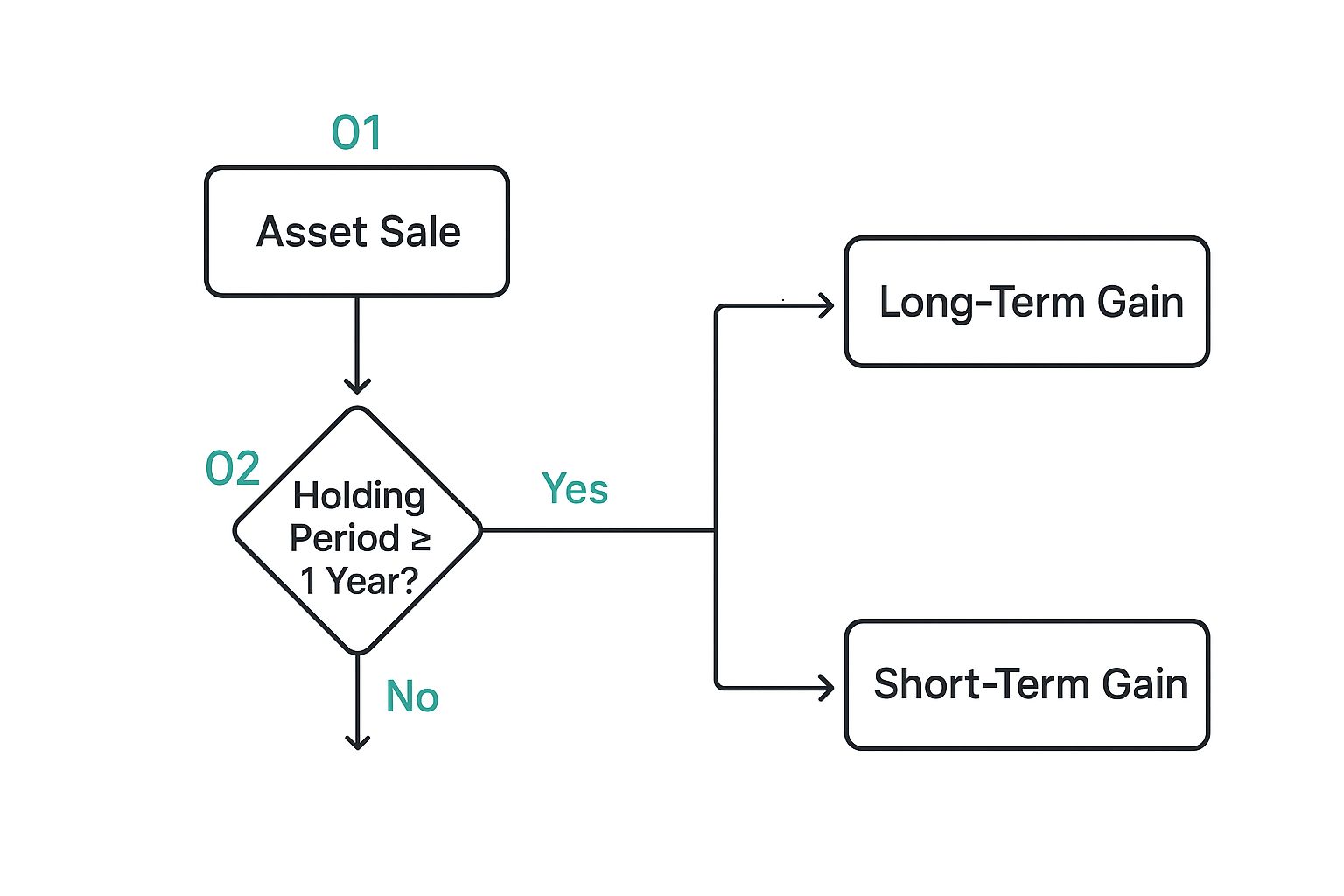
While the Dominican Republic uses a flat rate, it's still helpful to understand how other tax systems, like the one in the US, distinguish between short and long-term gains. It gives you a broader perspective when comparing international investment opportunities.
Ready to run the numbers on a specific property? Contact our Atlantique Sud agents for a personalized assessment.
Primary Residence Versus Investment Properties

When you start thinking about what capital gains taxes mean for you, the answer pivots on one simple question: are you selling your personal home or an investment property? Here in Las Terrenas, the Dominican tax authorities (DGII) see these two situations very differently. With over 25 years of guiding international buyers, we at Atlantique Sud have seen just how critical it is to understand this distinction from day one.
The tax bill for selling your permanent family home is not the same as the one for a rental condo you own for income. Let's break down how each is treated so you can plan your finances effectively.
Your Primary Residence Exemption
One of the best perks for homeowners in the Dominican Republic is the potential to be exempt from capital gains tax when you sell your main home. This isn't automatic, though. You have to meet specific conditions to qualify. Think of it as the government’s way of acknowledging the difference between a home and a business asset.
To be eligible for this exemption, you need to prove the property was your one and only primary home for a good while. The law can be nuanced, but the main requirements boil down to this:
-
Proof of Residency: You have to show that this was your main address. This can be backed up by utility bills in your name, local bank statements, and, most importantly, your official Dominican residency card.
-
Ownership Duration: You must have owned the property for a significant period, which is typically seen as no less than three years.
-
Exclusivity: This exemption usually only applies if it's your sole property in the country.
This is a huge reason why we often sit down with our clients to talk about their long-term plans. For anyone looking to relocate for good, getting legal residency is a vital first step. You can learn more about how to obtain Dominican residency through investment in real estate in our detailed guide. It's a process we know inside and out and can help you navigate.
The Investment Property Scenario
Now, let's switch gears to what most of our international clients are focused on: investment properties. These are assets bought with the main goal of making money, like a vacation rental villa or a condo managed for short-term stays. The Samaná Peninsula is a hot market for this, with properties in high-demand areas like El Portillo or Playa Popy often pulling in attractive annual rental yields between 7% and 10%.
When you sell an investment property, any profit you make is subject to the standard 27% capital gains tax. Simple as that. The property is treated purely as a business asset, and the gain from its sale is considered taxable income. This is a fundamental number you have to factor into your total return on investment calculations.
A common mistake foreign buyers make is assuming all property sales are treated equally. Structuring your purchase correctly from the beginning can save you tens of thousands of dollars in the long run. This is where our 25+ years of local market experience provides immense value.
For example, a $300,000 two-bedroom apartment in a modern condo complex in Las Terrenas could generate over $25,000 in gross rental income each year. If you sell it five years later for $425,000, the $125,000 gain will be fully taxable. Our job is to help you project these numbers accurately, including all costs and taxes, to make sure your investment aligns perfectly with your financial goals.
Whether you're dreaming of a retirement villa or building a portfolio of high-yield rental properties, the way you structure your purchase matters immensely. Should you buy as an individual or through a Dominican corporation? Each path has very different long-term tax implications. Contact our experienced agents at Atlantique Sud for a personalized consultation. We’ll walk you through clear scenarios for both property types, helping you make the most informed decision for your future in paradise.
Using a Corporation to Own Your Property
Over our 25+ years in the Las Terrenas real estate market, one of the most common questions we get is, "Should I buy my property through a Dominican corporation?" It's a great question. It shows you're thinking beyond just finding the perfect villa and moving into smart, long-term financial planning. For many foreign buyers, using a corporate structure is a powerful tool for managing assets here in the Dominican Republic.
The main draw is pretty compelling: holding your property inside a corporation can offer a completely legal way to sidestep capital gains taxes when you sell. The strategy is simple. You don't sell the property itself; instead, you sell the shares of the company that owns it. Since the property's title never actually changes hands, the 27% capital gains tax and the 3% property transfer tax are never triggered. This is a standard, above-board practice for savvy investors in the DR.
How to Form a Dominican Corporation (SRL)
The go-to corporate structure for this is a Sociedad de Responsabilidad Limitada (SRL). Think of it as the local version of a Limited Liability Company (LLC) you might be familiar with in North America. Setting one up is a surprisingly straightforward process that our team at Atlantique Sud handles all the time with our trusted local attorneys.
Here’s a quick breakdown of what’s involved:
-
Registration: It starts with registering the company name and filing the right legal documents with the Chamber of Commerce and the Dominican tax authority (DGII).
-
Cost: All in, the cost for formation usually lands somewhere between US$1,200 and US$2,500.
-
Timeline: From start to finish, the whole process takes about 3 to 4 weeks.
-
Compliance: Once it's set up, the SRL has minimal but mandatory annual compliance. This just means a simple tax filing, even if the company has zero income.
This structure gives you a clean, efficient way to hold your real estate asset.
Individual vs. Corporate Ownership: A Comparison
Deciding whether to buy in your personal name or through an SRL really comes down to weighing the pros and cons for your specific situation. This is a critical decision point where our decades of experience really become invaluable for our clients.
Buying as an Individual:
-
Pros: The initial transaction is simpler. You don't have corporate setup costs or annual compliance to worry about. It’s also the best route if you plan to use the primary residence exemption.
-
Cons: When you sell, it's a standard property sale, which means you'll be on the hook for the 27% capital gains tax. It also offers less liability protection and privacy.
Buying through an SRL:
-
Pros: You have the potential to legally avoid capital gains and transfer taxes by selling the company shares. It adds a layer of liability protection, keeping your personal assets separate from the property. Plus, it offers more privacy, as the property title is held in the company's name.
-
Cons: You have the initial setup costs and some small, annual compliance fees.
The corporate route makes the most sense for higher-value investment properties or for buyers who think they might sell within a 5 to 10-year window. In that scenario, the tax savings from a share sale will easily eclipse the setup and maintenance costs.
The 1% Annual Property Tax (IPI)
There's another critical piece to this puzzle: the annual 1% property asset tax, known as IPI. If an individual owns a property, this tax only kicks in for properties valued above a certain threshold (around US$175,000 as of 2024, and it's adjusted each year).
But here’s the important part: when an SRL owns the property, that 1% tax applies to the property's full value, right from the first dollar. There's no exemption threshold.
This is a calculation we run with our clients all the time. For a $500,000 villa, the annual IPI under an SRL would be $5,000. We help you weigh that annual cost against the potential $100,000+ you could save on capital gains and transfer taxes when you eventually sell.
The importance of a good tax strategy simply can't be overstated. To put it in perspective, in places like California, capital gains taxes are a massive source of state revenue—they collected $15.17 billion in a single year. The tax burden there is incredibly concentrated, with high-income earners shouldering 85.8% of all capital gains taxes paid. You can discover more insights about the impact of capital gains taxes in California to really appreciate why smart tax planning is so valuable.
Choosing the right ownership structure is one of the biggest financial decisions you'll make when buying here. Contact our expert team at Atlantique Sud, and we can walk you through it, providing personalized guidance that fits your investment goals.
Strategies to Legally Minimize Your Tax Burden
Paying taxes is an inevitable part of investing, but with smart planning, you don't have to overpay when you sell your property. After more than 25 years of guiding international clients here in Las Terrenas, our team at Atlantique Sud has learned that the best approach isn't about finding shady loopholes. It’s about knowing the rules and using them to your advantage to keep more of your hard-earned profits.
The single most powerful tool you have to lower your capital gains tax is something surprisingly simple: meticulous record-keeping. Every significant upgrade you invest in can increase your property's cost basis, which in turn directly shrinks your taxable gain. Think of every capital improvement as a direct investment in your future tax savings.
The Power of Meticulous Record-Keeping
When we talk about “capital improvements,” we mean substantial projects that add real, tangible value to your property—not just routine maintenance like a new coat of paint.
These are the kinds of upgrades that count:
-
Adding a Pool: A classic value-booster for a villa in the hills of Loma de la Piña.
-
Kitchen or Bathroom Remodel: Modernizing these crucial spaces in a condo near Playa Las Ballenas can make a huge difference.
-
Building an Addition: Constructing a new guest suite or expanding a terrace for more outdoor living space.
-
Major Landscaping: Professional projects that completely transform your property's curb appeal.
Let’s look at a real-world example. Say you purchase a villa for $450,000. Over the next three years, you install a beautiful new infinity pool for $40,000 and completely remodel the kitchen for another $25,000. Your cost basis is no longer just the purchase price; it's now $515,000. When you eventually sell, your profit is calculated from this much higher number, potentially saving you thousands. We always tell our clients to start a dedicated file—both digital and physical—for every single receipt and contract from day one. It pays off.
Leveraging the CONFOTUR Law
Another key strategy is to focus on properties covered by the CONFOTUR Law (Law 158-01). This law was created to encourage development in designated tourist zones, which luckily for us, includes many of the prime areas across the Samaná Peninsula. It’s a game-changer for savvy investors.
While CONFOTUR doesn’t get you out of the 27% capital gains tax when you sell, the benefits it offers during your ownership are immense and directly boost your overall bottom line. For up to 15 years, you can be exempt from:
-
The 3% property transfer tax.
-
The 1% annual property asset tax (IPI).
These savings add up, significantly improving your net returns while you own the property and making that eventual capital gains tax feel much more manageable. If you want to dive deeper, you can learn more about investing in tax-free real estate with the CONFOTUR law in our detailed guide. Our agents are experts at finding CONFOTUR-approved projects that offer the best long-term value.
Assembling Your Professional Team
Ultimately, the most effective strategy is not trying to do it all yourself. The Dominican Republic’s tax laws have local nuances that you simply can't grasp from afar. A successful, tax-efficient sale really hinges on having the right team of professionals in your corner.
This is a fundamental part of the service we provide at Atlantique Sud. We don't just find you a property; we connect you with our vetted network of trusted local accountants (contadores) and real estate attorneys. These experts work in concert to build a seamless strategy tailored to your specific situation, making sure every calculation is precise and every legal advantage is taken. Their role, from handling the official inflation adjustment on your cost basis to advising on the right corporate structures, is absolutely indispensable.
Your financial success in Las Terrenas is our number one priority. By combining our real estate expertise with the best legal and financial minds in the region, we make sure your investment is as profitable and tax-efficient as possible, from the moment you buy to the day you sell.
Partner With Experts for Your Property Sale
Successfully navigating the Dominican Republic’s real estate market—whether you're buying a dream property or selling for a profit—really comes down to deep, local expertise. Understanding what are capital gains taxes is a critical piece of the puzzle, but it’s not a journey you should take on your own. This is exactly where our team at Atlantique Sud becomes your most valuable partner.
With over 25 years of hands-on market experience right here in Las Terrenas, we do so much more than just help you find a beautiful villa. We look at the entire lifecycle of your investment. We connect you with our trusted network of vetted legal and financial professionals to handle every single detail of your sale, making sure it's as seamless as it is profitable.
Your Seamless Sale Process With Atlantique Sud
A property sale here involves a lot of moving parts where our experience can save you significant time, money, and headaches. The process typically moves from property valuation and marketing to negotiating offers and navigating the complex legal closing. We guide you through this entire journey, ensuring every document is in order and every tax consideration is thoughtfully addressed.
We see the big picture. From correctly calculating your cost basis to leveraging corporate structures for tax efficiency, our guidance is built on decades of successful transactions for international clients just like you. Our goal is to make the process feel completely transparent and secure.
Knowing the right steps to take and, more importantly, who to trust is what makes all the difference. Learning how to choose the right real estate agency in Las Terrenas for you is the first move toward a successful investment. We pride ourselves on being that essential partner for our clients, providing continuous support from the day you buy to the day you sell.
Whether you're selling a rental condo in Playa Popy that has seen fantastic appreciation or a cherished family home in the hills of Cosón, our team has the local know-how to maximize your outcome. We ensure you benefit from every available legal strategy, from inflation adjustments to meticulous record-keeping for all your capital improvements.
Ready to make a smart move in Las Terrenas? Contact our team today for a personalized consultation and let us put our 25+ years of success to work for you.
Frequently Asked Questions
When you're looking to invest in a place like Las Terrenas, it’s natural for questions to pop up. After more than 25 years in this market, we at Atlantique Sud have pretty much heard them all. Here are some quick, straightforward answers to the things foreign buyers ask us most about capital gains tax.
Does the CONFOTUR Law Exempt Me From Capital Gains Tax?
This is a big one, and it causes a lot of confusion. The CONFOTUR law (Law 158-01) offers some truly incredible tax breaks, like waiving the 3% transfer tax and the 1% annual property tax (IPI) for up to 15 years.
But here’s the key thing to remember: it does not get you out of the 27% capital gains tax when you decide to sell. That profit is still considered income in the eyes of the Dominican tax authorities. Even so, the overall savings make CONFOTUR properties fantastic investments. Our agents can walk you through specific CONFOTUR-approved listings and show you exactly what your net returns could look like.
What Happens if I Inherit a Property and Then Sell It?
Inheriting a property in the Dominican Republic involves a couple of key steps. First, you'll be subject to a 3% inheritance tax based on the property's appraised value at that time.
Now, this is critical: that appraised value becomes your new "cost basis." So, when you eventually sell the property, capital gains tax is only calculated on the profit you make above that new, higher inherited value (plus any adjustments). Handling inheritance matters requires solid legal advice, and we always connect our clients with our network of trusted local legal experts to ensure it's done right.
How Is the Inflation Adjustment for the Cost Basis Calculated?
This is a great feature of the Dominican Tax Code that can really work in your favour. It allows your original purchase price (your cost basis) to be adjusted for inflation, which can lower your taxable gain quite a bit.
The adjustment is based on the official Consumer Price Index (CPI) published each year by the Central Bank of the Dominican Republic. This isn't something that happens automatically, though. A local accountant, or contador, handles this calculation when they prepare your tax declaration for the sale. It's a crucial step we make sure is never missed for our clients.
Do I Also Pay Capital Gains Tax in My Home Country?
This really boils down to your home country's specific tax laws and its relationship with the Dominican Republic. Many countries, like the US and Canada, tax their citizens on worldwide income, which would include the profit from your sale here.
However, the good news is that tax treaties are designed specifically to prevent you from being taxed twice on the same income. These treaties typically let you claim a credit for the taxes you've already paid here in the Dominican Republic.
You absolutely need to talk to a tax professional in your home country to know exactly what your obligations are. We often work hand-in-hand with our clients' international advisors to make sure they have all the documentation they need from the sale.
Figuring out what are capital gains taxes and other local rules is where having real, on-the-ground expertise becomes invaluable. For personalized guidance on your own real estate journey in Las Terrenas, get in touch with the team at Atlantique Sud Real Estate. Let us put our 25+ years of market leadership to work for you. Learn more at https://realestatelasterrenas.com.